Category: ΝΕΑ ΕΞΩΤΕΡΙΚΟΥ

21
Οκτ

Italian Markets Set for Relief as Risk of Junk Rating Ebbs

Italian government bonds, stocks and debt from Europe’s other peripheral nations may rally on Monday after a ratings decision by Moody’s Investors Service removed the immediate threat of a downgrade to junk.

Moody’s cut Italy’s credit rank by one step to Baa3, its lowest investment-grade rating, on concern the government’s budget will erode its fiscal strength and stall plans for structural reform. But its decision to set the outlook for the assessment at “stable” may be enough to reassure investors after a selloff pushed yields on the nation’s 10-year bonds to the highest since 2014.

“This was the softest move possible and should be a relief for investors,” Ciaran O’Hagan, the head of euro-area rates strategy at Societe Generale, said in emailed comments. He recommended investors buy Italian government bonds after the decision. “Uncertainty has been removed. This deserves to be rewarded with a good rally.”

Company Rating Outlook Notches above junk
Moody’s Baa3 Stable 1
Standard & Poor’s BBB Stable 2
Fitch BBB Negative 2
DBRS BBBH Stable 3

Italy’s financial markets have been under pressure since the coalition government pushed for a higher-than-expected deficit in its budget, damaging investor confidence in its ability to reduce its 2.3 trillion-euro ($2.7 trillion) debt load and setting it on a collision course with European authorities. It also raised concern ratings firms would cut the nation below investment grade, triggering forced selling of government bonds.

While it leaves Italy with its lowest credit rating since the euro was formed, the downgrade fell short of investors’ worst expectations, paving the way for a relief rally. The 10-year yield touched 3.81 percent on Friday, a level last seen in 2014 when the nation was still recovering from Europe’s sovereign debt crisis. And while the securities did stage a late-day bounce to close at 3.48 percent, that’s still more than double this year’s lows and represents a premium of more than 300 basis points over benchmark German bunds.

By some measures, Italian bonds had already been trading in line with junk-rated nations.

SocGen wasn’t alone in expecting Moody’s to stick at a “stable” outlook. A one-step downgrade may see the 10-year yield spread narrow toward 250 basis points, Banco Bilbao Vizcaya Argentaria SA saidbefore the decision. Strategists at Citigroup Inc. saidthe yield gap would drop below 300 basis points in their base-case scenario of a one-notch downgrade and the removal of the negative outlook.

S&P Global Ratings, which rates Italy two notches above junk, is due to review the country on Oct. 26. Having upgraded Italy this time last year, that company “is not going to want to yoyo around,” SocGen’s O’Hagan wrote. Once its decision is out of the way, it will “eliminate one more uncertainty in the lead-up to year-end,” and that will translate into higher prices for Italian government bonds, he said.

Still, there are plenty of question marks hanging over Italy. Its swollen debt relative to its gross domestic product gives the government little financial wiggle room, while it remains under pressure due to internal disputes within the volatile coalition at home and European Union criticism of the budget.

The country’s biggest newspapers have already been running front-page stories about the bond spread as investors balk at the budget targets unveiled by the populist government. It may take further reassurances before “lo spread” — which entered Italian vernacular when the country was struggling to survive the European debt crisis — moves back out of the spotlight.

The prospect of turmoil within the ruling coalition is likely to become the dominant theme for bond investors from now on, according to Raffaele Bertoni, head of debt-capital markets at Gulf Investment Corp. in Kuwait City.

There’s a continued “risk of tension within the coalition over the budget,” Bertoni said in a Bloomberg TV interview. “Going forward, the market will focus more on the internal issues of the Italian government rather than the rating.”

The spread will tighten no more than 20 basis points on Monday, Bertoni added.

20
Οκτ

How Europe’s Key Election Is Leaving Voters Cold: Five Charts

Traders and investors have been glued to their screens as Italy’s populist government takes on the European Union establishment. The clash may provide a preview of the battle that will be played out in next year’s elections for the EU Parliament.

The continent’s politicians are gearing up for an epic campaign that may determine whether six decades of integration can survive a resurgence of nationalism.

Still, the voters who will decide are yet to really tune in, with a third saying they most likely won’t participate, according to the Eurobarometer survey published this week.

European voters have traditionally paid far more attention to their national elections than ballots for an EU legislature that still feels distant for many.

People really care about immigration, the key issue for nationalists like Italy’s Matteo Salvini and Viktor Orban of Hungary. The plan for more integration that French President Emmanuel Macron is pushing fails to stir passions in the same way.

It may be the U.K. that’s due to leave before the election, but Italians are even less enthusiastic about EU membership.

But most people aren’t even of when this election is due to take place anyway. (It’s May 23-26.)

18
Οκτ

Italian Bonds Plunge, Euro Slides as EU Takes Aim at Budget Plan

Italy’s bonds plunged Thursday just hours after the Treasury successfully conducted a bond-exchange operation as the European Union’s executive body dispatched a letter to the nation’s government and investors sharpened their focus on budget concerns. The euro also fell.

The yield on Italy’s 10-year surged as much as 15 basis points to around 3.70 percent on an intraday basis, widening the spread over equivalent German debt to levels unseen since 2013, while Europe’s common currency slid as much as 0.4 percent to $1.1455. Italy’s Draft Budgetary Plan for 2019 constitutes “an obvious significant deviation” from European Union rules, Commissioners Valdis Dombrovskis and Pierre Moscovici wrote in a letterto the country’s finance minister that was released publicly after the local bond market closed.

The missive from the EU marks the start of a process, which could culminate in a decision by the European Commission to issue a negative opinion next week — essentially rejecting Italy’s budget — and asking the Italian government to send it back with revisions. That has never happened before.

“The Italian government is going to get further into this standoff with the EU,” said Ben Emons, chief economist at Intellectus Partners LLC. “The market is continuing to realize that there is not going to be an easy resolve and there will be a lot of brinkmanship as we are seeing.”

Italian Finance Minister Giovanni Tria said the EU and Italy have different views about the country’s policies and he hoped “with dialogue” these views would “come closer together.” Moscovici said the letter is not final and there is still time which should be “used productively” to continue to exchange views.

European Central Bank president Mario Draghi for his part told EU leaders at a summit in Brussels Thursday that questioning the bloc’s rules can worsen financial conditions and damage growth, according to an official familiar with his remarks, which are likely aimed at Italy’s budget dispute with the Commission.

For story on EU’s comments on Italian budget, click here.

The country also faces credit-rating decisions from S&P Global Ratings and Moody’s Investors Service before the end of the month, with both companies ranking Italy just two notches above junk.

The market moves came in the wake of an bond exchange operation by the Italian Treasury, which saw the government switch 3.8 billion euros ($4.38 billion) of inflation-linked securities, known as BTP Italia, for five nominal bonds with maturities ranging from 2025 to 2046. That was more than the 3 billion-euro outlined by the Treasury beforehand, but bond investors soon took umbrage, pushing the yield spread over Germany to the highest level in more than five years.

‘Despondent Mood’

“The Treasury released much more duration in the market, which is going to weigh on BTPs as whole,” said Antoine Bouvet, a strategist at Mizuho International Plc. “This confirms the despondent mood in BTP markets.”

Italy’s bonds have been roiled in recent months by the prospect that its new government’s spending plans would fall foul of EU rules and add to its already hefty stock of debt — around 130 percent of gross domestic product. The Treasury likely wanted to take advantage of a slim window of opportunity before headlines continue to bruise Italy’s ailing debt market, according to Societe Generale SA.

“They need to raise cash so finding a quiet time to do that is important,” said Ciaran O’Hagan, head of European rates strategy. The Italian Treasury “needs to refinance maturing debt by issuing new bonds and that process is almost continuous given that Italy is Europe’s largest issuer.”

Italy bought back the BTP Italia maturing in April 2020 and sold bonds maturing in 2025, 2028, 2029 and 2046 through a syndication of banks. Italy’s 10-year yields climbed 11 basis points to 3.66 percent, with the spread over Germany hitting 326 basis points, the highest level since April 2013. The bonds of Spain and Portugal also dropped, with the former having to digest its own wave of supply, while yield on U.S. Treasuries fell amid a bid for safer assets.

12
Οκτ

Το ΔΝΤ αφήνει Ελλάδα-ΕΕ να λύσουν μόνες το θέμα των συντάξεων

Το θέμα των συντάξεων και το αίτημα της Ελλάδας να μην περικοπούν βρέθηκε ασφαλώς στην κορυφή της ατζέντας και από το ΥΠΟΙΚ υπογραμμίζεται ιδιαίτερα πως το ΔΝΤ θεωρεί ότι το μέγεθος του δημοσιονομικού χώρου είναι πρωτίστως ζήτημα μεταξύ Ελλάδας και Ευρωπαίων. Θα κριθεί δηλαδή στις συζητήσεις με την Κομισιόν για τον προϋπολογισμό.

Υπάρχει λοιπόν η ερμηνεία πως το ΔΝΤ δεν θα βάλει εμπόδια, σε περίπτωση που Ελλάδα και ΕΕ αποφασίσουν να μην εφαρμοστεί η περικοπή στις συντάξεις. Άλλωστε, πηγές του υπουργείου Οικονομικών αναφέρουν ακόμη πως το Ταμείο συμφωνεί με την άποψη της κυβέρνησης πως ο δημοσιονομικός χώρος πρέπει να ξοδευτεί προς όφελος της κοινωνίας και της ανάπτυξης.

Λαγκάρντ και Τόμσεν τόνισαν βέβαια στον Ευκλείδη Τσακαλώτο πως πρέπει να τηρηθούν οι δεσμεύσεις. Το Ταμείο θα παρακολουθεί την Ελλάδα, αλλά μοιάζει αυτή την ώρα να κάνει πίσω και να μην εμπλέκεται στη συζήτηση για τις συντάξεις, η οποία φαίνεται πως θα κριθεί στις συζητήσεις με την Κομισιόν για τον Προϋπολογισμό, αλλά και σε υψηλότερο επίπεδο, ανάμεσα στην Άνγκελα Μέρκελ και τον Αλέξη Τσίπρα.

Πηγή: reporter.gr

29
Σεπ

ITALY INSIGHT: Bad News on Budget Overshoot May Get Worse

The budget deficit unveiled by Italy’s populist government is far from disastrous for the country’s public finances. But it sets the coalition on a collision course with Brussels. That has unnerved investors and they could continue to put upward pressure on sovereign yields when additional details are released later today.

  • Italy set next year’s budget deficit at 2.4% of GDP. That would be unchanged from the shortfall registered for 2017, though it exceeds most of the figures leaked to the media.
  • Additional deficit projections for 2020 and 2021 should be released later today along with the GDP forecasts that underpin the estimates. All of those will be important to watch.

The figure announced last night in itself won’t wreak havoc on the country’s huge stock of debt. With a shortfall of 2.4% of GDP, the debt-to-GDP ratio should still fall slightly in 2018 to about 130.4% from 131.2%, according to our calculations.

Budget Deficit Fails to Narrow

The real problem for the Italian government is Brussels. An EU official told Bloomberg News that the headline deficit should have been around 1.6% to ensure a marginal improvement in the structural balance — that’s the cyclically adjusted balance excluding one-time items, such as bank bailouts. The IMF previously estimated the structural deficit would be about 1.3% for 2018.

It was only in negative territory because of the huge burden created by debt servicing costs. The primary balance, which excludes interest payments on government debt, should stand at about 1.9% at the end of this year. With the economy growing and inflation perking up, that’s still high enough to chip away at Italy’s huge stock of debt. However, the European Commission would like Italy to pay off the debt at a faster pace next year.

The next step for Italy will be to present the budget to the EC by Oct. 15. EU officials already have grounds to start an excessive deficit procedure. Under EC rules, if the debt-to-GDP ratio surpasses 60%, the overshoot must be reduced by 5% annually. (For example, if the ratio stands at 80%, it must fall by 1 percentage point each year.)

But launching an EDP is far from automatic. The EC examines each country’s fiscal situation and reports to the European Council on whether an EDP should be opened. The Council makes the final decision. Leniency can be shown for a whole slew of reasons.

As the EU official alluded to, the EC is unlikely to be overly lenient in the absence of any improvement in the structural balance. As part of the “preventive arm” of the EC’s fiscal rules, the structural budget deficit may not surpass a medium-term objective of no more than 0.5% of GDP if the debt-to-GDP ratio is above 60%. A compromise between Brussels and Rome will have to be found.

In the meantime, financial markets may do some of the EC’s work for it by applying pressure on Italian government bonds. The 10-year sovereign yield has risen 30 basis points today to 3.18%. Because the average maturity of Italy’s debt is seven years, the seven-year yield provides the best read on the damage that will eventually be done to the country’s finances. It now stands at 2.77%. A sustained rise of that figure above 3% would make the stock of debt too expensive to finance.

Seven-Year Yield Jumps

The coalition government has yet to release all the details of its budget projections – more bad news may lie ahead. It’s not just next year’s deficit that matters. The figures for 2020 and 2021 will also be in sharp focus. If the deficit exceeds 3% in either of these years, which may well be the case if the government’s spending plans are phased in over time, Italy’s sovereign yields would probably rise significantly — it would also cause major ructions with the EC.

Looking at the GDP projections used to calculate the deficits will be important as well. We forecast GDP growth of 1.1% in 2019 and 2020, slowing to 1% in 2021. The IMF expects 1.1%, 0.9% and 0.8%, respectively. The EC forecasts 1.1% in 2019. Any projections from the Italian government significantly above those rates would cast doubt on the credibility of the budget forecasts.

28
Σεπ

Italy’s Budget May Be Worrying, But Pessimism Is Overblown

By Anchalee Worrachate

(Bloomberg) — The Italian-German yield spread shot up by nearly 40 bps to 275 bps, the biggest one-day move since May when the populist government was formed. While investors are probably right to be nervous, the pessimism might arguably be overblown. This is something to be expected given the elections pledges. A few months ago, some were even talking about deficits as big as 6%-7% and risk of a euro exit. Neither of those have materialized.

But in the near-term, it will be hard to stand in the way of this outgoing high-speed train. Most investors are understandably worried. The compromise demolished Finance Minister Tria’s credibility, according to Christoph Rieger at Commerzbank (he closed long BTP from Aug. 30 last night).
“Having a lame duck finance minister in this situation will require a higher premium,” he said.
The current BTP-bund spread is just 15 bps away from a five-year high reached last month. Fidelity International said it sees the proposed budget as tantamount to throwing down a gauntlet to the EU and that’s not going to bode well for sentiment. Now, the spotlight has shifted to how the EU will respond.

17
Σεπ

Mε 10ετές ομόλογο θα βγει η Κύπρος στις αγορές

Οι τράπεζες Barclays, J.P. Morgan, Morgan Stanley και Societe Generale ορίστηκαν ως ανάδοχοι για πιθανή έκδοση, στο εγγύς μέλλον, Ευρωπαϊκού Μεσοπρόθεσμου Ομολόγου (ΕΜΤΝ), 10ετούς διάρκειας σε ευρώ (Reg S benchmark, με Ρήτρες Συλλογικής Δράσης) ανάλογα με τις συνθήκες στην αγορά, όπως ανακοίνωσε σήμερα το Γραφείο Διαχείρισης Δημοσίου Χρέους της Κυπριακής Δημοκρατίας.

Στην ανακοίνωση σημειώνεται ότι η Κυπριακή Δημοκρατία έχει βαθμό πιστοληπτικής ικανότητας Ba2 (σταθερή)/ BBB- (σταθερή)/ BB+ (θετική)/ BB (θετική) από τους οίκους Moody’s / S&P / Fitch / DBRS.

Το Ευρωπαϊκό Μεσοπρόθεσμο Ομόλογο (ΕΜΤΝ), 10ετούς διάρκειας, που αναμένεται να εκδώσει η Κυπριακή Δημοκρατία, θα είναι στο 1 δισεκατομμύριο ευρώ.

Για την επικείμενη έκδοση του ομολόγου και τη σύνδεσή του με την πώληση της Συνεργατικής Κυπριακής Τράπεζας, μίλησε ο υπουργός Οικονομικών, Χάρης Γεωργιάδης, στο ΡΙΚ.

“Είμαστε κατά κάποιο τρόπο στο ακουστικό να επιβεβαιώσουμε μέσω των επενδυτικών τραπεζών, με τις οποίες συνεργαζόμαστε, αν είναι πράγματι η κατάλληλη στιγμή. Φαίνεται πως είναι” ανέφερε ο κ. Γεωργιάδης και πρόσθεσε: “Σκοπός δεν είναι να καλύψουμε κάποια ελλείμματα, τρύπες. Ο στόχος πρέπει να είναι, βάσει και των δεδομένων των διεθνών αγορών, κάθε πράξη καινούριου δανεισμού να εξασφαλίζεται με καλύτερους όρους, με χαμηλότερο επιτόκιο από το υφιστάμενο χρέος. Αν το πετύχουμε και αυτό, θα υπάρχει ένα άλλο όφελος για τα δημόσια οικονομικά. Βεβαίως, το πολύ πιο σημαντικό όφελος από μία αναβάθμιση και κυρίως από την επάνοδο στην επενδυτική βαθμίδα είναι το έμμεσο αλλά καθοριστικής σημασίας θετικό μήνυμα που αποστέλλεται στη διεθνή επενδυτική κοινότητα, αλλά και στο εσωτερικό που ενθαρρύνει και άλλες επενδύσεις, ενθαρρύνει την επενδυτική και οικονομική δραστηριότητα”.

Πηγή: ΑΠΕ-ΜΠΕ

14
Σεπ

Debt Relief Will Help Greece Repay ‘In the Medium Term’: ECB Chief

FRANKFURT (Reuters) – The debt relief granted by euro zone governments to Greece will increase the country’s ability to repay its dues “in the medium term”, the president of the European Central Bank, Mario Draghi, said in a letter published on Friday.

“We welcome the agreement reached by the Eurogroup on 22 June, which we believe will improve debt sustainability in the medium term,” he said in a letter to a member of the European Parliament.

“We also welcome the Eurogroup’s readiness to consider further debt measures in the long term in case adverse economic developments were to materialize.”

14
Σεπ

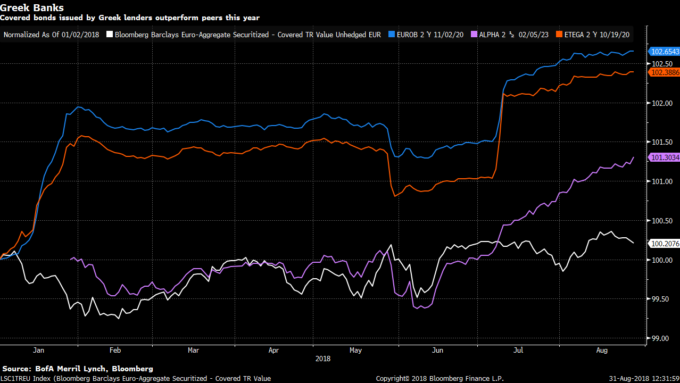
Nordea’s Top Covered Bond Fund Bets on Greece for Fattest Return

The covered bonds team at Nordea is betting on Greece.

“At the moment we see good value in Greek covered bonds, which we’ve been invested in since October last year,” Henrik Stille, portfolio manager, said in an interview on Monday. “We still see some value there.”

Greece turned a page on the sovereign debt crisis that exploded eight years ago, exiting a bailout on Aug. 20. Earlier in the month, Fitch Ratings upgraded the country one step to BB- citing improved “general government debt sustainability” and noting that confidence in the banking sector is rising.

Nordea’s Danish fixed income and European covered bond team manages about 39 billion euros ($45 billion). Its European Covered Bond fund has returned 4.3 percent a year on average over the past five years, beating 90 percent of its peers, according to data compiled by Bloomberg.

It holds about 100 bonds including debt issued by National Bank Greece SA. Stille says it’s also still possible to find some “attractive opportunities” in Denmark and Sweden, as the Scandinavian markets aren’t trading as tight as their European counterparts.

“From time to time, we also see value in Denmark and Sweden,” he said. “But it’s not the overall market that is attractive. It’s more specific segments of these markets we like.”

Active Strategy

The fund doesn’t take any duration bets but has an active strategy based on relative value.

“The relative value between the markets can vary quite a lot in a year,” he said. “Especially between the markets in euro and the markets in the domestic Scandinavian currencies. It’s important to be active and move the exposure around.”

Tapering by the European Central Bank won’t have a big impact on covered bond spreads as the bank will keep reinvesting, Stille said.

“Many of the core European countries — like Germany, France, Netherlands and Scandinavia — there we think covered bonds are rather attractive versus government for example,” he said. “Even though spreads are a bit tight in absolute terms we don’t think that they are too expensive.”

Nordea’s low duration European covered bond strategy, which has a duration of one year compared with five years for the European Covered Bond fund, has experienced big inflows, passing 1 billion euros in assets after being launched in October last year.

“Investors don’t think that they’re getting compensated enough for taking risk in the financial markets at the moment,” he said. “It’s better to buy covered bonds that are the safest bonds you can invest in, because then you get an investment that is much safer if we run into financial turmoil.”

12
Σεπ

ECB Said to Lower Euro-Area Growth Outlook on Global Demand

ECB Said to Lower Euro-Area Growth Outlook on Global Demand

Economic forecasts starting 2018 to be revised down slightly

  • Projections will be unveiled by President Draghi on Thursday
By Jana Randow and Alessandro Speciale

(Bloomberg) — 

The European Central Bank is set to tweak its forecasts lower for euro-area economic growth as global trade tensions damp external demand, according to officials familiar with the latest projections.

The predictions for output have been cut slightly starting this year, the people said, asking not to be named because the assessment is still confidential. The U.K. and Turkey are among nations dragging on demand, though the U.S. outlook is still positive, the officials said.

The darker outlook comes at an awkward time for the Governing Council as it prepares to wind back stimulus, though the adjustments probably aren’t big enough to derail those plans yet. The path of inflation, the primary consideration for monetary policy, is largely unchanged, the officials said.

The euro slipped after the report and traded at $1.1589 at 12:22 p.m. Frankfurt time.

The ECB committee that oversees the compilation of the forecasts now sees the risks to economic growth as tilted to the downside, according to the people. While that’s a change from policy makers’ latest view that the risks are “broadly balanced,” the Governing Council could choose to disagree with that assessment and keep its existing language at its meeting on Thursday.

An ECB spokesman declined to comment.

“We’ve thought for months that it was a little strange to say risks are balanced, when every single one mentioned was on the downside,” said Nick Kounis, an economist at ABN Amro Bank NV in Amsterdam. “Given the ECB hasn’t said risks are tilted to the downside until now, it would be surprising if they changed their outlook now, even though it would be justified.”

President Mario Draghi, who will unveil the final projections after the Governing Council meeting, has acknowledged the damage to confidence from protectionist threats and global uncertainties in recent months. Since then, Turkey and Argentina have slid deeper into crisis, triggering turmoil across the emerging-markets world, and the U.K. is still at risk of breaking away from the European Union without a trade agreement.

Economists surveyed by Bloomberg last week said they expect officials to confirm that monthly bond buying will be reduced to 15 billion euros ($17 billion) from 30 billion euros starting next month, before ending in December. Interest rates are seen rising in late 2019.

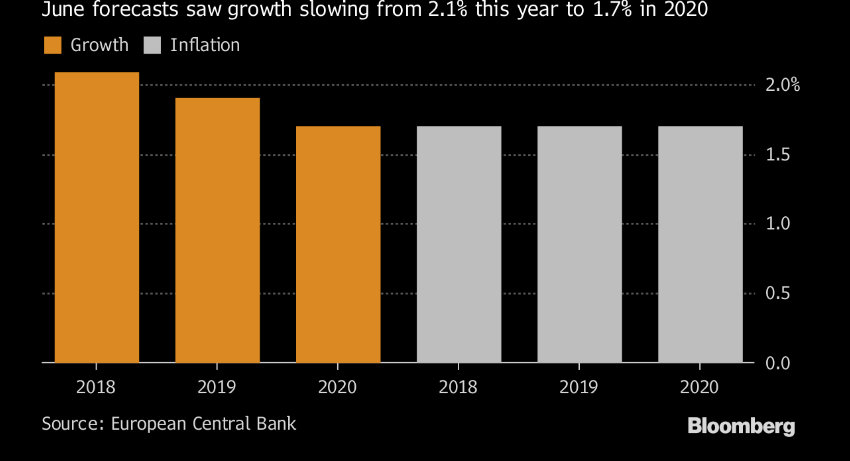
In June, the ECB predicted economic growth would slow from 2.1 percent this year to 1.7 percent in 2020, with inflation averaging 1.7 percent in all three years covered in the forecast.

Comodo SSL