Italian Bonds Rally as Salvini Seen Open to Compromise on Budget
By John Ainger
(Bloomberg) —
Italian bonds climbed after a report that Deputy Prime Minister Matteo Salvini may be open to revisions on a budget criticized by the European Union.
Ten-year bond yields headed for the biggest drop this month and the euro rose after La Stampa newspaper reported Salvini may be willing to lower spending. The European Commission is due to publish its assessment of the budget at 11 a.m. London time, with a rejection potentially leading to fines for the country.
Italy’s 10-year bond yields fell 12 basis points to 3.50 percent, having touched 3.72 percent Tuesday, the highest level since Oct. 19. The spread over those on their German peers narrowed to 313 basis points.
“If the comments from Salvini are true and some sort of compromise is found, sanctions may even be avoided, which would make it likely indeed that the BTP-bund spread retightens back to the 250-275 area,” said Martin van Vliet, senior interest-rate strategist at ING Groep NV.
The euro extended an advance to gain 0.3 percent to $1.1400, as its correlation with Italian bond moves increased. Italy’s FTSE MIB Index rose 1 percent, snapping five days of losses.
If the EU follows through with sanctions, it could levy fines of 0.2 percent of Italy’s gross domestic product, which could increase to 0.5 percent if the government in Rome doesn’t amend its budget.
Nouy Says ECB Stress Test Didn’t Show Banks Need Recapitalizing
By Nicholas Comfort
(Bloomberg) —
The ECB’s test of how banks would fare under economic distress didn’t reveal a need to recapitalize any of the lenders, says Daniele Nouy, head of the central bank’s banking supervision arm.
As in previous years, the ECB will make “more severe” demands on some banks for how much capital they should hold, while others face “slightly better guidance”
“The result of the stress tests are reasonably favorable. We do not have cases like we did in 2016 where there was a need for recapitalization”
Stress tests can be improved in order to offer supervisors greater insight into the health of banks
On Italian banks, she said: “We monitor the situation of all banks in all countries carefully and obviously the Italian spreads are unwelcome in this perspective, but it is not the last time that we will have to face questions like that”
NOTE: The ECB didn’t publish the results of ~60 banks that it examined in parallel to the European Banking Authority’s test disclosed this month
European Banks Split Between the Haves and Have-Nots Is Clearer
(Bloomberg Intelligence) — The malaise surrounding EU banks, with limited catalysts and growing macro fears, received little cheer at 3Q. HSBC, Barclays, ING, SEB and StanChart were among our preferred 3Q reports, as BNP, Nordea, UBI and Metro continue to struggle. Revenue expectations remain flat in aggregate, with further provision cuts likely. The capital and payout outlook is also largely unchanged. (11/14/18)
1. Barclays, ING Emerge Relative 3Q Victors as Deutsche, RBS StallReturn to Top
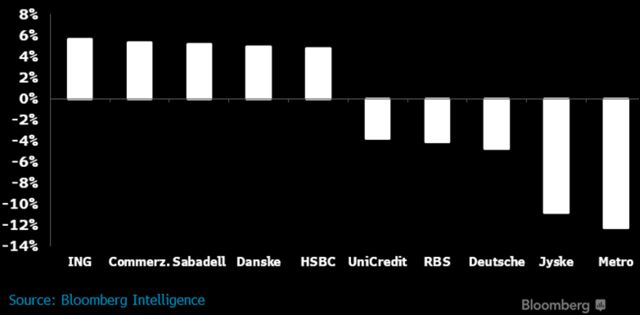
1-Day Winners, Losers After 3Q Results Release
The average share price move of the 40-plus European banks on the trading day after they released 3Q results was 0.1%, which masks a very wide spread in performance. Metro Bank fell the most (12%), followed by Jyske (11%), Deutsche (5%) and RBS (4%). The biggest gainers were ING (6%) and HSBC (5%), which posted strong results. Commerzbank, Sabadell and Danske also bounced 5%, though we are less sanguine about the quality of their results. Barclays, Standard Chartered and Intesa all delivered positive surprises and outlooks, we feel, while Nordea, UBI and BNP’s results and commentary — albeit pre-empted by weak share price performance — also disappointed. (11/14/18)
2. DNB, Erste Lead Revenue Growth as Barclays Joins the Top PackReturn to Top
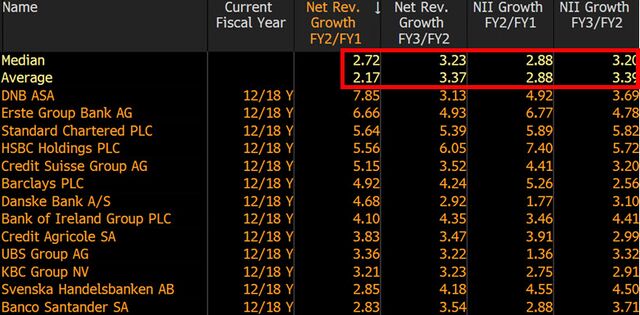
2019 – 2020 Revenue Growth
Expectations for average net interest income and total revenue growth in 2019 and 2020 have been marginally trimmed since mid-year, but are up 0.3% since 3Q earnings. UBS, Barclays, BCP and HSBC have received the largest post-3Q upgrades on net interest income. Average top-line growth is now expected to accelerate from 2% in 2019 to 3% in 2020. Fee growth and interest income growth are expected to be roughly even. HSBC’s return to growth is now baked into 6% expectations that have held steady. DNB and Erste lead expectations, even as consensus continues to moderate for both.
Consecutive good quarterly reports have led to Barclays revenue upgrades, putting it among the top-6 large cap banks on growth. ABN Amro, Natixis, Banco BPM, Nordea and RBS are the main banks expected to report small (1-3%) revenue contractions in 2019. (11/14/18)
3. 2019 Consensus Provisions Have Room to FallReturn to Top
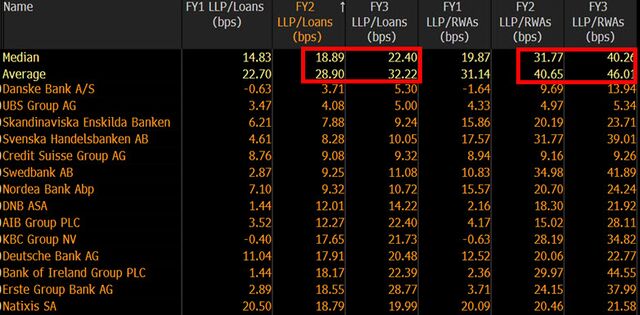
The median provision charge for EU banks (including Nordics) is expected to rise from 20 bps (as a percentage of RWAs) in 2018 to 32 bps in 2019, and 40 bps in 2020. We estimate that 2019 consensus charges may tick lower in early 2019, though acknowledge that IFRS 9 may bring some negative surprises, likely back-ended to late-2019. The majority of 2019 expectations have been revised lower since 3Q results, with RBS, Allied Irish Banks, HSBC, Standard Chartered and the French banks taking the largest cuts. (11/14/18)
2019 Provision Expectations Have Room to Fall
4. Consensus CET1 Development Is Marginally NegativeReturn to Top
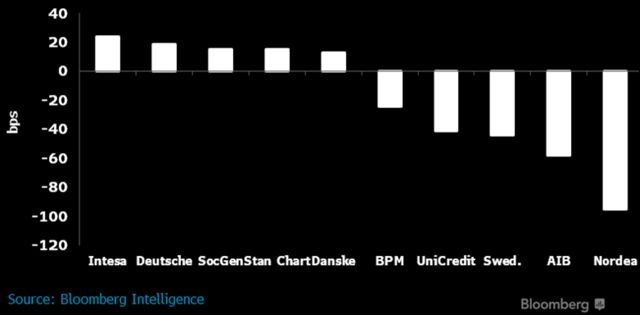
Change in 2019 CET1 Consensus
Average CET1 expectations for 2019 have fallen 6 bps since the start of 3Q earnings, with Nordea (95 bps), Allied Irish Banks (58 bps), Swedbank (44 bps), UniCredit (41 bps) and Banco BPM (24 bps) leading the fall. Conversely, Intesa (24 bps), Deutsche Bank (19 bps), SocGen and Standard Chartered (both 15 bps) and Danske (13 bps) surprised positively, leading to consensus upgrades. Swedish banks will see further cuts to consensus CET1 as 25% risk-weighting is applied to their domestic mortgage books. Average expected payout ratios remain flat for 2019 and 2020, at 50% and 55%, respectively.
Natixis (107% and a special dividend of 1.5 billion euros likely in early 2019), Nordea (93%), Intesa (80%), SEB and Handelsbanken (75% each) lead the payout ranking for 2019. ABN’s 3Q update on Basel IV impacts cut payout expectations. (11/14/18)
5. European Banks’ Promise of 10% EPS Growth Could Well Be BrokenReturn to Top
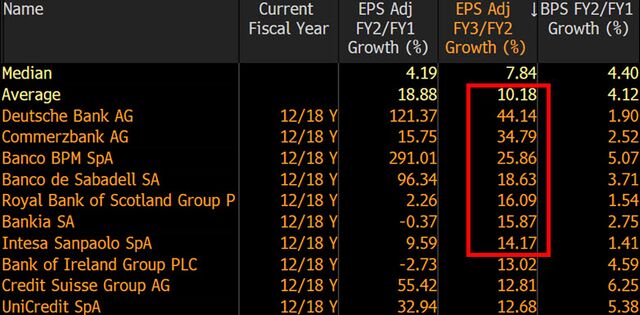
Consensus estimates for the European banks suggest that average EPS growth in 2020 could rise to more than 10%, with recovery stories including Deutsche Bank, Commerzbank, Banco BPM, and RBS leading the charge. We believe that revenue pressures will lead to top-line disappointments, leaving overdelivery on cost control as the major determinant of share prices into 2019. Further, we would expect another round of bloodletting within the IB space as MiFID II bites and margin slippage continues. Lower provisions will offset some of the revenue weakness, as will new cost cutting plans. (11/14/18)
6. Cost-Income Targets Let Down Top-LineReturn to Top
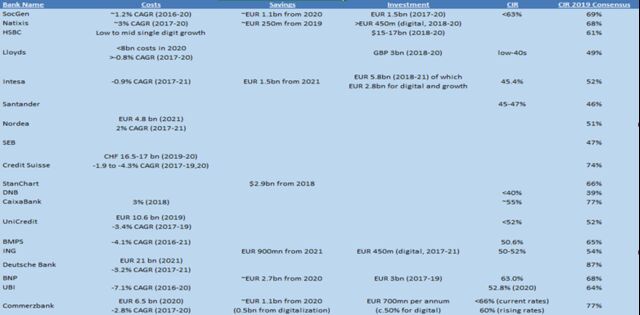
The multi-billion dollar investment programs most banks are currently pursuing, as well as weak revenue, suggest to us that the majority of European banks will miss their respective cost-income targets. Consensus shows that DNB, Santander (where a new plan is due) and UniCredit are three of the very limited number of lenders expected to deliver on cost-income ratio targets, which we believe is true. Lloyds’ top-line momentum, with a material pickup in non-interest income needed, suggests that despite being one of the most efficient banks in Europe, it will also miss its efficiency goal. (09/27/18)
(Bloomberg) —Italy signaled it’s not ready to budge on its controversial budget even as euro-area finance ministers called on it to prepare revised spending plans that comply with the bloc’s rules, in a sign that the standoff between Brussels and Rome is set to escalate in the coming weeks.
The finance chiefs’ call comes amid a dispute over budget plans that the EU says go against Italy’s commitments to reduce its debt load. In an unprecedented rebuke, the European Commissionasked Italy last month to submit revised spending plans by Nov. 13, after it essentially rejected the country’s budget for 2019, saying that it constitutes a clear deviation from commonly agreed rules.
Giovanni Tria
But despite repeated warnings, Italian Finance Minister Giovanni Tria told reporters after the meeting in Brussels on Monday with his euro-area counterparts that the government would not change the budget law. The defiance means that even though Italy is willing to engage in talks with the commission over its spending plans, it’s unlikely to make sufficient concessions to appease Brussels.
“We expect a new and revised draft budgetary plan by Nov. 13 and that is a necessity,” EU economic affairs chief Pierre Moscovici told reporters after the meeting. “And the questions we have raised are still on the table.”
Better Explanations
The commission’s call for a revised budget came after months of discord over the spending targets, which sent Italian bond yields to a four-year high last month.
But Tria also expressed optimism that Italian securities would recover. “We hope that the spread will go down when our strategy is better understood,” he said. “And maybe after the dialogue with the commission.”
During Monday’s meeting, the Italian finance chief told his colleagues that the country’s planned deviation was not huge and that EU rules allow for some flexibility, while he reiterated his government’s commitment to reduce the country’s debt load, an official familiar with the discussion said.
But Italy’s willingness to further explain the numbers and policies in the spending plans is unlikely to be enough to address the commission’s concerns.
In a joint statement, the bloc’s ministers said they agreed with the assessment by the commission and called on Italy to engage in “open and constructive dialogue” and to cooperate closely with the commission “in the preparation of a revised budgetary plan which is in line with the stability and growth pact.”
The statement also stressed the importance of sufficient debt reduction, a clear message to Italy, which has the highest debt ratio in the euro area after Greece.
‘Plan B’
Despite repeated warnings, Prime Minister Giuseppe Conte has said there’s no “Plan B” for the fiscal program, indicating the government has little intention to comply with EU demands.
Once Italy responds to the commission, the EU’s executive arm will have three weeks to publish its final assessment on whether the country’s spending plans are in breach of EU rules. One possible outcome, EU officials say, would be for the commission to bring up to Nov. 21 the publication of a report on Italy’s compliance with EU rules on debt that was originally planned for the spring.
EU Rules
If the report shows that Italy is failing to comply with rules on reducing its debt — which is more than twice the EU limit — then that could trigger the so-called excessive deficit procedure, a process that could eventually lead to financial sanctions for the government in Rome. The penalty could reach 0.2 percent of the country’s annual economic output, which was 1.7 trillion euros ($1.9 trillion) in 2017.
Financial penalties proposed by the commission have to be approved by member states, which can block the process. But while Brussels has limited powers over national budgets, governments have in the past sought to avoid an official reprimand because of the stigma and the potential market implications.
Under EU rules, no country should have a budget deficit larger than 3 percent of gross domestic product or debt above 60 percent of output and those that are outside of those limits must set annual targets to show they’re moving in the right direction. While Italy’s deficit is well within the 3 percent limit, the commission has demanded smaller gaps for the country to bring down its debt load.
(Bloomberg) —Prime Minister Giuseppe Conte is seeking to mediate between the coalition partners backing Italy’s government and the European Union to ease tensions amid a standoff over the country’s proposed budget for 2019, Il Messaggero reported Sunday.
Among the proposals for compromise: up to 17 billion euros ($19.4 billion) earmarked for the so-called citizens income program and for reform of the pension system could be placed in a separate fund as a “standby,” the newspaper said, without citing anyone.
The funds would then be attributed to the relevant programs “only if the situation permits it,” Messaggero reported. Reform of the pension plan, originally targeted at a cost of 7 billion euros, could fall to 5.5 billion euros.
Conte and Finance Minister Giovanni Tria, “with tacit support” from the government’s main backers, Matteo Salvini of the League and Luigi Di Maio of the Five Star Movement, have also floated a possible “re-modulation” of the citizen’s income program — an aid plan for needy Italians.
The possible adjustments could bring Italy’s deficit to 2.3 percent, compared with the 2.4 percent in the current budget plan, Messaggero reported, citing a person working on the plan.
ECB Sticks to Plan to Curb Stimulus Even on Darker Outlook
Decision comes after lackluster growth, confidence indicators
Mario Draghi holds media briefing at 2:30 p.m. in Frankfurt
By Xiaoqing Pi(Bloomberg) —
The European Central Bank still intends to cap its bond-buying by year-end and leave room for an interest-rate increase late next year, even amid mounting signs that the euro-area economy is wilting under global pressures.The Frankfurt-based institution said it will buy 15 billion euros ($17 billion) of bonds a month through December, with a final decision to end the program contingent on incoming information. Policy makers reiterated that interest rates will remain at their present record lows “at least through the summer” of 2019.
ECB interest rates
Current level
Deposit rate
minus 0.4 percent
Main refinancing rate
zero
Marginal lending rate
0.25 percent
Attention now turns to President Mario Draghi’s press briefing at 2:30 p.m. in Frankfurt, where he will explain the Governing Council’s decision.
The euro was barely moved by the statement, trading up 0.2 percent at $1.1411 at 1:56 p.m.
“Expect a dovish spin in the press conference,” said Christoph Rieger, Commerzbank AG’s head of fixed-rate strategy. “Deteriorating economic and market sentiment are increasing the risks to the ECB’s baseline scenario.”
A key point investors will focus on is the assessment of economic prospects. Since policy makers characterized risk to the outlook as “broadly balanced” six weeks ago, domestic momentum has weakened and uncertainty around global growth has increased.
A gauge for private-sector growth in the euro area slowed to the weakest since 2016 — a level IHS Markit said Wednesday “would historically be consistent with a bias toward loosening monetary policy.” Confidence in the region’s largest economy slid.
Draghi’s list of concerns is long. Underlying inflation continues to be muted, trade tensions between the U.S. and China are starting to take their toll on the Asian economy and export-focused companies in Europe and around the world, and risks of a disorderly Brexit are running high.
A standoff between the Italian government and the European Commission over the country’s budget probably also features prominently. The spread between Italian and German 10-year bonds is hovering near a five-year high, approaching levels seen as unsustainable for banks.
Moreover, global markets have tumbled this month. An equities rout wiped out U.S. gains for the year, and the Stoxx Europe 600 is down almost 8 percent this month.
Investors are also looking for information on whether the ECB will change its reinvestment policy once net purchases end.
Italy’s Conte Rules Out `Plan B’ on Budget as He Seeks Dialogue
Premier Giuseppe Conte speaks in Bloomberg interview in Rome
Conte says ‘we are not gamblers,’ Italy won’t leave EU or euro
By John Follain and Alessandra Migliaccio
(Bloomberg) —
Italian Prime Minister Giuseppe Conte insisted his government has no “Plan B” to change its budget, despite the skeptical responses of the European Commission and investors.
Conte said in a Bloomberg News interview that he was looking forward to talking with European commissioners and explaining the 2019 budget to them. He suggested that Italy has some leeway to tweak aspects of the plan, and not actual spending. But if he is asked to change the substance, “it will be difficult for me because I cannot accept that.”
Giuseppe Conte in Rome, Oct. 23.
“There isn’t any B plan,” Conte said in the interview in English at his Rome office on Tuesday. “I said that the deficit at 2.4 percent of GDP is the cap. I can say this will be our cap,” he said, in reference to the planned budget deficit for next year.
Italy’s populist government, a coalition of the anti-establishment Five Star Movement and the anti-migrant League, looks to be on a collision course with Brussels as its spending targets far exceed EU limits. The commission, the EU’s executive, is due to respond to Italy’s spending plans later on Tuesday, when it may opt to formally demand that Rome takes back, revises and resubmits its budget.
Euro Commitment
Financial markets are responding to Italy’s chafing at EU rules. Italian bonds fell for the fourth time in five sessions earlier on Tuesday, while the 10-year spread over similar German debt touched a five-year high during trading on Friday.
“We are ready to reduce maybe, to operate a spending review if necessary,” Conte said. “You have to consider that we are not gamblers that are betting on our kids’ future on the roulette.” Economic growth is “the best way in order to take us out of a debt trap,” he said.
Conte dismissed the prospect of the spread with German bunds reaching 400 basis points, a level that Credit Suisse AG said could put unsustainable pressure on Italy’s banking system. He also reaffirmed Italy’s commitment to the euro. “I have the evidence that part of the spread is due to the prospect of Italexit,” Conte said.
“I can assure that this executive will not accompany this country, Italy, out of Europe,” he said. “We feel very comfortable, we feel at home in Europe and we think that the euro is our currency and will be our currency, the currency of my kid, he’s 11 years old, and the currency of my grandchildren.”
Italy Calls for Dialogue on `Necessary’ Breach of Deficit Rules
By Kevin Costelloe and Lorenzo Totaro
(Bloomberg) —
Italy’s populist government promised it won’t let its budget deficit widen further than currently planned and called for dialogue with the European Union to address their differences.
In a letter to the European Commission published Monday, Finance Minister Giovanni Tria said the government is ready to act to ensure it doesn’t exceed the 2.4 percent target for 2019. He said he’s aware that his spending plans don’t comply with EU rules and he wants “constructive” talks with officials in Brussels. Prime Minister Giuseppe Conte, speaking in Rome, said the deficit target should be seen as an upper limit and it could still be narrower.
Giovanni Tria
The decision to increase spending was “difficult though necessary,” Tria said in his letter. He cited slow economic growth and the “difficult economic situation the poorest segments of the Italian society are facing.”
Italian bonds rose slightly, with the spread over German 10-year yields narrowing by 6 basis points to 296. The gap reached a five-year high of 341 basis points during trading on Friday.
Tria has come under fire from officials and investors since bowing to pressure from Italy’s coalition heavyweights Matteo Salvini and Luigi Di Maio to allocate resources to their key election promises: tax cuts, more benefits spending, and a lower retirement age. The Commission expressed “serious concern” about Italy’s budget plans in a letter on Thursday.
Delayed Benefits
The finance chief offered no indication that he plans to back down from the headline spending targets, paving the way for the EU to take the unprecedented step of demanding revisions. EU commissioners will discuss the letter response at a meeting in Strasbourg Tuesday, commission spokesman Margaritis Schinastold reporters in Brussels.
“While recognizing the divergence of the respective evaluations, the Italian government will remain in a constructive and fair dialogue,” Tria added. “The government is confident it can get investment and GDP growth moving again and that the recent rise in the government bond yields will be reabsorbed as the investors learn about all the details of the measures in the budget law.”
He added that after 2019 the government doesn’t intend to raise the structural budget deficit — adjusted to take account of the economic cycle and one-time items.
Prime Minister Conte signaled that Italy may not implement some of its most controversial spending plans until later next year, which could potentially lead to a narrower deficit. While the move is unlikely to appease the EU Commission, it was a sign that the government in Rome is looking at ways to reach a face-saving compromise.
“We can still reassess during the budget implementation whether to contain the target so we don’t necessarily need to reach that 2.4 percent,” Conte said. “For sure, we won’t exceed it.”
Italy Refuses to Back Down on Budget Deficit in Response to EU
By Kevin Costelloe and Lorenzo Totaro
(Bloomberg) —
Italy’s government refused to back down on its budget targets in its reply to European Union criticism of its 2019 spending plans.
In a letter to the European Commission, Finance Minister Giovanni Tria said the government is aware that its plan is “not in line with the applicable norms” of the EU’s stability pact. The letter said if economic growth is better than expected, the structural-deficit targets may be revised.
Tria also said that the government will intervene should the deficit and debt ratios exceed what is targeted in the budget.
Euro could revisit its year-to-date low as persistent political risks may lead Mario Draghi to refrain this week from painting a rosier picture for the bloc’s economy.Market dynamics have shifted only slightly since the European Central Bank’s last meeting, yet not in a supportive way for the common currency. Data may be suggesting the forecasts for growth are broadly on track with the Governing Council’s projections, but on the other hand subdued inflation, early signs of contagion in peripheral bonds, deadlocked Brexit negotiations and a hawkish Federal Reserve could mean the euro could test its $1.1301 mid-August low.
Draghi said he sees a “relatively vigorous” pickup in underlying euro-area inflation following the September monetary policy decision and while wage pressure is building, the pass-through to prices is yet to be seen. At a time when the market looks behind the curve when it comes to additional U.S. tightening, there may be little room for the ECB president to downplay monetary policy divergence projections at the next gathering on Oct. 25.
Price action in the spot market this month showed that the euro could benefit from a Brexit resolution. U.K. and EU officials keep kicking the can down the road however as obstacles remain, with focus now turning to a December EU summit, as volatility shows. European Council President Donald Tusk and European Commission President Jean-Claude Juncker present conclusions from the Oct. 18-19 summit to the EU Parliament this week, with the bar high for a positive surprise.
For the short-term, investors are looking closely at the performance of euro-
area peripheral bonds as the rift between Italy and the EU widens. Italy’s 10-year yield spread over Germany touched the highest in more than five years following a letter from the European Commission to Rome that said its spending plans were excessive. While resilience was the name of the game initially, Spanish bonds led the widening versus bunds on Thursday and the 10-year Portugal yield rose by 8 basis points Friday to 2.11 percent, highest since May.
The euro hit $1.1433 on Friday, flirting with a two-month low. Bloomberg’s fear-greed indicator shows bears are in firm control of price action, while a crossover in short-term moving averages suggests the latest rally for the dollar has legs to follow.
Leveraged names may be short the euro already, yet model names are seen selling technical breaks, according to two traders in Europe, who asked not to be identified because they are not authorized to speak publicly. As the market looks short gamma below $1.1400, further weakness for the common currency could mean traders will need to chase the market lower. As long as the euro stays below its 55-daily moving average, currently at $1.1579, bulls will be kept on their toes.