Category: ΝΕΑ ΕΣΩΤΕΡΙΚΟΥ

31
Αυγ

Επίδομα €360 αντί σύνταξης σε υπερήλικες που χρωστούν στον ΕΦΚΑ

Επίδομα ανασφάλιστου υπερήλικα της τάξης των 360 ευρώ το μήνα αντί για σύνταξη μπορούν να λάβουν χιλιάδες ελεύθεροι επαγγελματίες, αυτοαπασχολούμενοι ή αγρότες που παραμένουν “εγκλωβισμένοι” εκτός συστήματος κοινωνικής ασφάλισης λόγω οφειλών.

Όπως επισημαίνει σε δημοσίευμά της η “Καθημερινή”, τη δυνατότητα λήψης του συγκεκριμένου επιδόματος σε ασφαλισμένους που δεν μπορούν να λάβουν σύνταξη γήρατος λόγω οφειλών στον ΕΦΚΑ, δίνει εγκύκλιος που υπεγράφη χθες, από την αναπληρώτρια υπουργό Κοινωνικής Αλληλεγγύης, Θεανώ Φωτίου και τον υφυπουργό Κοινωνικής Ασφάλισης Τάσο Πετρόπουλο.

Πρόκειται στην ουσία για ασφαλισμένους, κυρίως επιτηδευματίες και ελεύθερους επαγγελματίες, που ενώ πληρούν τις ασφαλιστικές προϋποθέσεις για τη λήψη σύνταξης, έχουν δηλαδή συμπληρώσει το προβλεπόμενο κάθε φορά όριο ηλικίας συνταξιοδότησης και τον απαιτούμενο χρόνο ασφάλισης, βρίσκονται εγκλωβισμένοι λόγω οφειλών.

Η εγκύκλιος, αναφέρεται στο δημοσίευμα, εντάσσει στις προϋποθέσεις λήψης επιδόματος ανασφάλιστου υπερήλικα την ύπαρξη χρεών, με αποτέλεσμα να ανοίγει ο δρόμος έστω για τη λήψη 360 ευρώ το μήνα.

Πηγή: Capital.gr
31
Αυγ

Les Echos: Η Ελλάδα βγαίνει στις αγορές με έκδοση ομολόγων το Σεπτέμβριο

Σύμφωνα με προβλέψεις της Natixis, η νέα έκδοση θα γίνει στο τέλος Σεπτεμβρίου

Με ιδιαίτερο ενδιαφέρον αναμένουν οι επενδυτές την έξοδο της Ελλάδας στις αγορές, αναφέρει η γαλλική Les Echos. Σύμφωνα με την οικονομική εφημερίδα, το Σεπτέμβριο για πρώτη φορά μετά τη λήξη του προγράμματος η χώρα μας θα βγει στις αγορές, προχωρώντας στην έκδοση ομολόγων, συνολικού ύψους τριών δισ. ευρώ.

«Η χώρα έχει ήδη πραγματοποιήσει μια πρώτη έκδοση 3 δισ. ευρώ τον περασμένο Φεβρουάριο. Μετά την έξοδό της από το πρόγραμμα βοήθειας στις 19 Αυγούστου, δεν μπορεί παρά να στηριχθεί μόνο στις αγορές για να χρηματοδοτήσει το χρέος της. Η Natixis υπολογίζει σε 8 δισ. την έκδοση των ελληνικών ομολόγων για εφέτος. Η τράπεζα προβλέπει μια νέα έκδοση, ύψους 3 δισ. ευρώ, στα τέλη Σεπτεμβρίου. Αυτή θα είναι η πρώτη της φορά που θα βγει ως δανειολήπτης στις αγορές, όπως και οι άλλες χώρες» αναφέρεται σε άρθρο της Les Echos.

Στο δημοσίευμα τονίζεται πως τα περισσότερα κράτη μέλη της Ευρωζώνης θα πρέπει να πραγματοποιήσουν το 30% έως 50% του προγράμματος έκδοσης ομολόγων τους μέχρι το τέλος του χρόνου, πριν από το 2019 που θα χαρακτηρίζεται από το τέλος των αγορών τίτλων από την ΕΚΤ (QE).

Συνολικά η Ευρωζώνη αναμένεται ότι θα δανειστεί 860 δισ. δολάρια από τις αγορές το επόμενο έτος, όπως αναφέρει το ΑΠΕ-ΜΠΕ.

30
Αυγ

Greek Banks a Buy Again Showing More Light Than Shade, HSBC Says

Greek Banks a Buy Again Showing More Light Than Shade, HSBC Says

Thursday, August 30, 2018 10:38 AM

HSBC analyst Jason Kepaptsoglousees more light than shade at Greek banks, and recommends buying all four major lenders, albeit with reduced price targets.

  • Country is on the right path; trends in asset quality are improving in line with expectations, NPL sales pipeline and large corporate restructurings “appear to be strong”
    • NOTE: Aug. 28, Greek Bank Chiefs Say They Can Handle Loss of ECB Waiver
  • Cautions that operational profitability is under more pressure than thought, prompting analyst to cut profit estimates
  • Still, despite top-line pressures, Greek banks should deliver healthy capital-adjusted returns post-restructuring
  • Valuation now more appealing with market value down 30% since April highs
  • Upgrades Eurobank (PT EU1.25), NBG (PT EU0.29) and Piraeus (PT EU3.20) to buy from hold
  • Reiterates buy for Alpha bank (PT EU2.43)
29
Αυγ

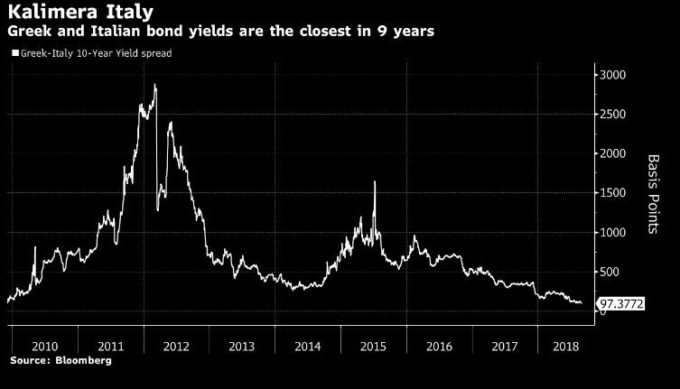
Greek Bond Yield Premium Over Italy the Lowest Since 2009: Chart

The spread between Greek and Italian benchmark bonds narrowed below 100 basis points for the first time since 2009 as continued tensions ahead of Italy’s budget and forthcoming credit ratings updates keep its bonds in focus.

Italy, which has the highest debt load in Europe, faces a likely confrontation between the ruling populist coalition and the European Union on its first budget next month and a possible Moody’s downgrade at the end of October.

Greece, with Europe’s highest debt-to-GDP ratio, came out of its bailout this month.

Source: Bloomberg

28
Αυγ

Ελληνες τραπεζίτες: Non event η άρση του waiver

Την πεποίθηση ότι η άρση του waiver είναι αντιμετωπίσιμη καταθέτουν στο Bloomberg οι επικεφαλής των τεσσάρων συστημικών τραπεζών.

«Οι ελληνικές τράπεζες έχουν ήδη αντικαταστήσει το μεγαλύτερο μέρος της έκτακτης χρηματοδότησης στην κορύφωση της κρίσης με δανεισμό από τις αγορές», τονίζει ο Φωκίων Καραβίας, CEO της Eurobank. «Αν δεν υπάρξει σημαντική περαιτέρω επιδείνωση της κατάστασης στις αγορές δεν περιμένουμε δυσκολίες στη χρήση των υπόλοιπων ελληνικών ομολόγων για παρόμοιες χρηματοοικονομικές συναλλαγές».

Το αντίκτυπο από το ότι δεν θα μπορούμε να χρησιμοποιούμε ελληνικό χρέος θα είναι ελάχιστο, εκτιμά ο Παύλος Μυλωνάς της Εθνικής Τράπεζας.

Από την πλευρά του, ο Χρήστος Μεγάλου της Πειραιώς πηγαίνει ακόμα παραπέρα περιγράφοντας την άρση του waiver ως πρακτικά «μη γεγονός» (non event). Η τράπεζα έχει πάρει μέτρα για μεταφέρει περίπου 1 δισεκατομμύριο χρηματοδότησης από την ΕΚΤ στη διατραπεζική αγορά repos.

Από την πλευρά της, η Alpha Bank ΑΛΦΑ +0,29% έχει διατηρήσει γραμμές χρηματοδότησης από την ΕΚΤ αντικαθιστώντας ελληνικά κρατικά ομόλογα και έντοκα με άλλο ενεργητικό που γίνεται αποδεκτό από την ΕΚΤ, υποστηρίζει ο Δημήτριος Ματζούνης. Η τέταρτη μεγαλύτερη ελληνική τράπεζα έχει επίσης αυξήσει τις συναλλαγές στην αγορά repos με διεθνείς αντισυμβαλλόμενους.

Καθώς οι τράπεζες ετοιμάζονται να ανακοινώσουν αποτελέσματα εξαμήνου οι επικεφαλής τους δηλώνουν ότι αυτό που χρειάζεται περισσότερο η Ελλάδα είναι να συνεχίσει τις μεταρρυθμίσεις και να προσελκύσει επενδύσεις. Για τις ίδιες η μεγαλύτερη πρόκληση είναι αντιμετώπιση του όγκου των μη εξυπηρετούμενων δανείων. Τους επόμενους μήνες θα παρουσιαστούν σχέδια ώστε το ποσοστό τους από κοντά στο 50% να μειωθεί γύρω στο 15% (σ.σ. mid-teens) ως τα τέλη του 2021.

«Επιπλέον βελτίωση της επενδυτικής εμπιστοσύνης για να προσελκυστούν εγχώριες και ξένες επενδύσεις απαιτεί σταθερή υλοποίηση των δομικών μεταρρυθμίσεων και αναμόρφωση του φορολογικού βάρους», δηλώνει ο Π. Μυλωνάς. «Τα βασικά ρίσκα, πέρα από τη μεταρρυθμιστική κόπωση προέρχονται από εξωτερικούς παράγοντες», με τους δυο γείτονες (Τουρκία, Ιταλία) να αντιμετωπίζουν οικονομικές δυσκολίες, προσέθεσε.

Πηγή: euro2day.gr

28
Αυγ

Greek Bank Chiefs Say They Can Easily Handle Loss of ECB Waiver

Greek Bank Chiefs Say They Can Easily Handle Loss of ECB Waiver

  • Heads of lenders say Greece needs investment, bad-loan cleanup
  • CEOs of four systemic bank speak about the challenges ahead
By Sotiris Nikas and Marcus Bensasson

(Bloomberg) — 

Greek bank bosses brushed off concerns that the end of a special rule giving them access to the European Central Bank’s cheap money will spell trouble.

The expiry of Greece’s bailout program last week came with a catch. It ended outside control of Greece’s economic policy, but forced the country’s banks to stand on their own two feet again, even though they still have the worst bad loan problem in Europe. While the program ran, the ECB waived a rule stopping it from accepting the country’s junk-rated sovereign bonds as collateral. As such it was able to supply vital liquidity.

That waiver is now over.

At the peak of the debt crisis, Greece’s banks needed over 150 billion euros ($175 billion) of liquidity from the ECB, having lost almost all interbank funding and much of their deposit base. That need has now fallen to only 13 billion euros, as of the end of July. Of that, only around 3.5 billion is backed by Greek government collateral that is now ineligible for ECB operations.

As such, all four chief executive officers of Greece’s systemic lenders told Bloomberg News they’re confident they can get by.

“Greek banks have already substituted the bulk of the emergency liquidity at peak crisis with market funding,” said Fokion Karavias, chief executive officer of Eurobank Ergasias. “Bar a significant further deterioration of market conditions, we expect no difficulty in using the remaining Greek government bonds for similar market transactions.”

The impact from not being able to use Greek government debt will be “minimal,” said National Bank of Greece chief executive Paul Mylonas.

Christos Megalou, chief executive of Piraeus Bank, went further, describing the removal of the waiver as “practically a non-event.” His bank, the country’s biggest by assets, has taken measures to shift about 1 billion euros of ECB funding onto the interbank repo market, he said.

Read More: Why Greek Banks’ New Loans Are Not Enough for Cratered Economy

Alpha Bank has maintained funding lines from the ECB by substituting Greek government bonds and treasury bills with other ECB-eligible assets, according to its chief executive, Demetrios Mantzounis. Greece’s fourth-biggest lender has also increased its open market repo transactions with international counterparties, he said.

Attracting Investment

As the Greek banks prepare to report their financial results for the first half of the year this week, the banks’ bosses said that what Greece needs most is to follow through with the reforms that will attract investment.

The major challenge ahead for the banks will be managing the stocks of non-performing exposures, which at close to half of all loans are the most in the euro area, according to Eurobank’s Karavias. In the following months, they will be presenting regulators with plans to reduce the ratio to the mid-teens by the end of 2021, he said.


Greece remains Europe’s most indebted country as a proportion of gross domestic product, and the economy is still struggling to recover from the loss of more than a quarter of its output during the crisis. The unemployment rate is still almost 20 percent, making it hard for people to repay their bank loans.

“Additional improvement in confidence to attract both domestic and foreign investment requires the steady implementation of structural reforms, and a rebalancing of the tax burden,” said National Bank’s Mylonas. “The main risks other than implementation fatigue arise from external factors,” with the country’s two largest neighbors — Turkey and Italy — both experiencing economic difficulties, he said.


27
Αυγ

Dijsselbloem: Greece is freer now to implement some more social type of policy

Aug. 27 (ANA-MPA) — Greece now has “the flexibility to apply a more social type of policy,” Jeroen Dijsselbloem, former president of the Eurogroup, told private ANT1 television in an interview on Monday night, warning however that “it must not repeat the mistakes of the past.”

The former Dutch minister expressed optimism for the Greek economy’s future and said it would take time for Greece to restore its credibility and overcome the great issues its population is facing.

Among other comments, he noted that the European Union had made mistakes in the management of the Greek economic crisis and said the fiscal adjustment programs for Greece were very strict and their implementation very difficult. He said that Greek politicians were also responsible for many mistakes even before the crisis, as was Germany for its delayed reaction to agreeing to a unified EU plan in order to contain the widespread economic crisis.

He also described the handling of the crisis by then Finance Minister Yanis Varoufakis as “catastrophic” and said that negotiations were held directly with Prime Minister Alexis Tsipras to find solutions which however were constantly being undermined by Varoufakis.

27
Αυγ

Κατά 10,1% αυξήθηκε η κίνηση στα ελληνικά αεροδρόμια το πρώτο επτάμηνο

27 Αύγουστου (ΑΠΕ-ΜΠΕ) — Ανοδική πορεία σημειώθηκε στα αεροδρόμια της Ελλάδας το επτάμηνο Ιανουαρίου-Ιουλίου 2018 καταγράφοντας αύξηση 10,1% σε σύγκριση με το αντίστοιχο περυσινό διάστημα.

Από τα στατιστικά στοιχεία της ΥΠΑ για την κίνηση των αεροδρομίων το επτάμηνο Ιανουαρίου- Ιουλίου του 2018 προκύπτει ότι συνολικός αριθμός των διακινηθέντων επιβατών έφθασε τα 34.384.666 παρουσιάζοντας αύξηση 10,1% σε σχέση με το αντίστοιχο διάστημα του 2017 όπου είχαν διακινηθεί 31.237.352 επιβάτες.

Συγκεκριμένα οι διακινούμενοι επιβάτες είναι αυτό το διάστημα περισσότεροι κατά 3.147.314 σε σχέση με το αντίστοιχο περσινό διάστημα.

Ο συνολικός αριθμός των πτήσεων στα ελληνικά αεροδρόμια ανήλθε στις 289.453 (από τις οποίες 113.694 εσωτερικού και 175.759 εξωτερικού) παρουσιάζοντας άνοδο 8,3%, σε σχέση με το αντίστοιχο διάστημα του 2017 όπου είχαν πραγματοποιηθεί 267.253 πτήσεις.

Επίσης, από τα στατιστικά στοιχεία για τον μήνα Ιούλιο προκύπτει ότι διακινήθηκαν στα ελληνικά αεροδρόμια 9.923.674 επιβάτες και η άνοδος έφτασε μεσοσταθμικά το 8,9%. Ο συνολικός αριθμός των πτήσεων στα ελληνικά αεροδρόμια ανήλθε στις 77.882 παρουσιάζοντας αύξηση 9,7% σε σχέση με το αντίστοιχο διάστημα του 2017 όπου είχαν πραγματοποιηθεί 71.012 πτήσεις.

Αξίζει να αναφερθεί ότι οι αφίξεις επιβατών εξωτερικού έφτασαν τα 4.049.160 παρουσιάζοντας επίσης άνοδο 8,9% σε σχέση με το 2017 που είχαμε 3.718.805 αφίξεις.

Στα αεροδρόμια Αθηνών, Ηρακλείου, Ρόδου, Θεσσαλονίκης και Κέρκυρας καταγράφεται η μεγαλύτερη επιβατική κίνηση Ιουλίου 2018.

Τέλος τα αεροδρόμια Σητείας, Μήλου και Νάξου κατέγραψαν την μεγαλύτερη ποσοστιαία αύξηση επιβατών το επτάμηνο Ιανουαρίου- Ιουλίου του 2018.

Ο αερολιμένας που είχε το μεγαλύτερο ποσοστό αύξησης διακίνησης επιβατών είναι το αεροδρόμιο Σητείας με άνοδο 101,9%, (διακίνησε 33.110 επιβάτες το επτάμηνο του 2018 έναντι 16.402 το αντίστοιχο διάστημα του 2017).

Το αεροδρόμιο Μήλου κατέγραψε άνοδο επιβατικής κίνησης 74,4%, (διακίνησε 43.914 επιβάτες έναντι 25.176 το περσινό διάστημα) και το αεροδρόμιο της Νάξου σημείωσε αύξηση 60,1% καθώς διακίνησε 46.404 επιβάτες το επτάμηνο του 2018, έναντι 28.983 επιβατών που είχε διακινήσει το 2017.

27
Αυγ

Liakos to ANA: The challenges of the next day

Aug. 27 (ANA-MPA) — The end of the third programme on August 20, the only programme that was successfully concluded, marks the end of a particularly and long period of difficulties and the entry into a new era, Deputy Minister to the Prime Minister Dimitris Liakos, said on Monday in an interview with the Athens-Macedonian News Agency (ANA).

The end of the memoranda is a reason for reflection and self-awareness in order to see and analyze soberly the real causes, pathogens and the political weaknesses and responsibilities that led us to the necessity of avoiding a disorderly default through programs with significant structural weaknesses that did not take into account particularities and the deeper problems of the Greek economy and, in particular, of the structured state institutions and the public administration.

At the same time, the new challenging period presents an excellent opportunity to objectively record the real strengths, weaknesses and problems of the country in order to come up with a robust, documented and holistic plan for the future. The beginning was made by tabling the national development strategy, which is an appropriate basis for dialogue on the next steps.

The end of the memoranda is a fact of exceptional historical significance. It is a success of the country, the Greek people, which justifies feelings of joy and satisfaction, but in no case should it cause euphoria and complacency. It is true that important and necessary reforms have taken place in many different areas in recent years. However, there is still a lot to be done. We must continue the effort to transform the economy, to modernize the public administration and, above all, to support society.

It is also true and unquestionable that the country will, after many years, recover significant and sufficient degrees of freedom to pursue policies that will create the right conditions not only for returning to normal but for creating a modern country for which citizens will be proud of. It is a good time to seize this opportunity and transform it into an opportunity for the country.


24
Αυγ

FITCH RATINGS: WEST EUROPE SOVEREIGN UPGRADES CONTINUE

Fitch Ratings-London-24 August 2018: Rating momentum for Western European sovereigns remained positive in recent months, with three rating upgrades (Cyprus, Greece and Andorra) since April 2018 and no downgrades, Fitch Ratings says. Three countries are on Positive Outlook (Austria, Cyprus and Finland). The United Kingdom and San Marino are on Negative Outlook. The UK’s Outlook reflects the continued downside risks of a disruptive exit from the EU.

Of the three countries that were upgraded, two – Cyprus and Greece – have each been upgraded by a total of five notches since mid-2015 as they have completed European Stability Mechanism (ESM) programmes (Greece exited its latest programme on 20 August).

More broadly, strong growth and improving public finances have underpinned improvements in Western European sovereign creditworthiness in recent quarters. General government deficits and debts are declining across most countries in the region. Near-term growth fundamentals remain solid, boosted by favourable financing conditions, robust employment growth and improving business profitability. Resilient domestic demand provides some offset to the drag from slowing global trade.

However, the prospect of slower GDP growth and higher interest rates means that further fiscal efforts may be required by highly indebted countries to place debt on a firm downward trajectory as politics becomes less conducive to tighter fiscal policies and structural reforms.

The shifting political backdrop is seen in strong election results by parties critical of “austerity” and, more generally, the whole EU framework, most notably leading to the formation of a coalition government in Italy led by the Five Star Movement and the Lega. The electoral campaign for next year’s European Parliament elections is likely to exacerbate divisions between pro- and anti-EU parties. Rising political uncertainty could further undermine recent positive growth dynamics if falling business confidence led to weaker capex growth.

Greece’s ESM programme exit marks an important milestone. On 10 August, we upgraded Greece’s foreign- and local-currency ratings to ‘BB-‘ from ‘B’. The upgrade reflects improved public debt sustainability, underpinned by debt relief measures agreed by European creditors, a track record of general government primary surpluses, our expectation of sustained GDP growth, additional fiscal measures legislated through to 2020, and somewhat reduced political risks.

The UK’s ‘AA’ rating remains on Negative Outlook. We think a smooth transition from EU membership has become less likely. An intensification of the political divisions within the UK and slow progress in negotiations with the EU mean there is such a wide range of potential Brexit outcomes that no individual scenario has a high probability. An acrimonious and disruptive “no deal” Brexit is a material and growing possibility. This would substantially disrupt customs, trade and economic activity, with the depth of disruption depending on how quickly a “bare bones” deal could be reached.

Source: Bloomberg

Comodo SSL