Category: ΝΕΑ ΕΣΩΤΕΡΙΚΟΥ

26
Νοέ

Greece’s Eurobank Seeks Revival With $8 Billion Bad-Loan Plan

Greece’s Eurobank Seeks Revival With $8 Billion Bad-Loan Plan

  • Plan to securitize bad debt includes merger with Grivalia
  • Bank expects to reduce troubled loans to 15% of total in 2019
By Marcus Bensasson and Sotiris Nikas

(Bloomberg) — 

Greece’s Eurobank Ergasias SA isn’t waiting around for a state rescue, with a plan to sell about 7 billion euros ($8 billion) of troubled loans and merge with a real estate fund.

As part of the plan, the bank will merge with real estate fund Grivalia Properties REIC to create a new business named Eurobank, the two companies said. It will then shift non-performing debt to a separate vehicle that will issue senior, mezzanine and junior notes that the bank will initially retain. Some of the lower level notes would then be sold off to investors.

Read more: New Bank’s Biggest Investor Keeps Faith After Losses

Eurobank is seeking its own solution to a mountain of bad debt while Greece races to find a nationwide approach to accelerating the sale of soured loans. The government and central bank are weighing solutions that include providing state guarantees and easing payments for borrowers with modest means.

“The merger is equivalent to a stealth recap for Eurobank, not in cash but in real estate,” Thanassis Drogossis, head of equities at Athens-based Pantelakis Securities wrote in a note to clients. The deal, if approved by regulators, will result in “faster balance sheet healing,” he said.

Shareholder Uncertainty

Eurobank jumped by as much as 25 percent in Athens then lost most of the advance to trade up 3.4 percent at 49 cents as of 3:30 p.m. Grivalia gained as much as 15.2 percent, its largest increase since June 2012 and was up 7.8 percent. The benchmark FTSE/Athex index also pared gains of almost 12 percent and was 4 percent higher.

Under the plan, Eurobank will retain the most senior portion of the securitized non-performing exposures, while the first losses will be borne by Eurobank shareholders who will be allocated junior notes. Between those will be a mezzanine tranche, some of which will go to Eurobank shareholders with some sold to investors.

The deal will see Eurobank’s non-performing exposures drop to about 15 percent of total loans by the end of 2019 from the current 39 percent, then into single digits by 2021, according to the statement. The deal will also strengthen the restructured lender’s capital ratio.

The transaction values Grivalia shares at a 9 percent premium on their Friday close, the companies said. That sets the price of the acquisition at about 790 million euros.

The deal reunites Eurobank with Grivalia, which was first listed in its real estate unit in 2006 under the name Eurobank Properties REIC. The name was changed to Grivalia in 2014 as Eurobank cut its stake under regulatory pressure.

Positive Step

Eurobank’s plan for bad loans is a positive step for Greek banking and it proves that there is a lot of resilience and value, Piraeus Bank Chief Executive Officer Christos Megalou said in a Bloomberg TV interview.

Fairfax Financial Holdings Ltd., which currently holds an 18 percent stake in Eurobank and a 51 percent stake in Grivalia, will become the largest shareholder in the new lender with 33 percent, according to the statement.

Once the problem loans are taken out “you’ll have a very well capitalized bank in a very good position to serve the Greek clients as well as the Greek economy,” Fairfax founder Prem Watsa said in an interview with Bloomberg.

The exchange ratio proposed is about 15.81 new Eurobank ordinary shares for every one Grivalia ordinary share, according to the statement. Eurobank shareholders will retain the number of Eurobank ordinary shares they currently hold, the companies said.

Shares in the merged company will start trading on April 24, according to the statement.


26
Νοέ

Eurobank, Grivalia Properties to Merge, Securitize NPEs

Greece’s Eurobank Ergasiasannounced plans to merge with real estate fund Grivalia Properties in a deal that will see the lender also securitize about 7 billion euros ($7.9 billion) of troubled loans.

The deal will see the bank’s ratio of non-performing exposures drop to about 15 percent by the end of 2019, from 39 percent currently, then into single digits by 2021, the two companies said in a joint statement. The deal will also increase the restructured lender’s common equity tier one ratio to 16.6 percent from 14.6 percent currently.

Shares in the merged company will start trading on April 24, according to the statement. The deal boosts Eurobank’s capital by more than 800 million euros, according to a person familiar with the deal, who asked not to be identified.

The exchange ratio proposed is about 15.81 new Eurobank ordinary shares for every one Grivaliaordinary share, according to the statement. Eurobank shareholders will retain the number of Eurobank ordinary shares they currently hold, the companies said.

22
Νοέ

EFSF Approves Medium-Term Debt Relief Measures for Greece

EFSF Approves Medium-Term Debt Relief Measures for Greece

Thursday, November 22, 2018 02:36 PM

The Board of Directors of the European Financial Stability Facility approved the implementation of a set of medium-term debt relief measures for Greece, according to a press release.

  • Euro area finance ministers had endorsed the measures in June
  • “We estimate that the total package of medium-term measures agreed by ministers last June should lead to a cumulative reduction of Greece’s debt-to-GDP ratio of around 30 percentage points until 2060,” ESM Managing Director and EFSF CEO Klaus Regling says in statement
  • Measures include deferral of interest and amortisation by 10 years on EU96.4b of EFSF loans to Greece and extension of the maximum weighted average maturity of these loans by 10 years
  • The board also approved the abolition of an annual penalty attached to some of the country’s loans
21
Νοέ

Εγκρίθηκε ο ελληνικός προϋπολογισμός – Καμία περικοπή στις συντάξεις

Την πρώτη έκθεση στο πλαίσιο ενισχυμένης εποπτείας για την Ελλάδα ενέκρινε η Ευρωπαϊκή Επιτροπή.

Σύμφωνα με την ανακοίνωση της Επιτροπής, η έκθεση καταλήγει στο συμπέρασμα ότι το σχέδιο προϋπολογισμού που υπέβαλε η Ελλάδα για το 2019 «εξασφαλίζει τη συμμόρφωση με τη δέσμευσή της να επιτύχει πρωτογενές πλεόνασμα ύψους 3,5 % του ΑΕΠ».

Επιπρόσθετα, η Κομισιόν χαρακτηρίζει «μέτρια» την πρόοδο όσον αφορά τις μεταρρυθμίσεις σε άλλους τομείς, καλώντας τις Αρχές να «επισπεύσουν την υλοποίησή τους για να επιτευχθούν οι στόχοι τους».

Συγχρόνως, επισημαίνει ότι η τελική έκθεση, βάσει της οποίας θα αποφασιστεί η εφαρμογή των μέτρων για το χρέος, που περιλαμβάνουν τις επιστροφές των ANFAs και SMPs, θα δημοσιευθεί στις αρχές του επόμενου έτους.

«Η ενεργοποίηση των μέτρων για το χρέος, η οποία θα εξαρτάται από την εφαρμογή συγκεκριμένων πολιτικών και συμφωνήθηκε στο πλαίσιο της σημαντικής δέσμης μέτρων για το χρέος που αποφασίστηκε κατά τη συνεδρίαση της Ευρωομάδας της 22ας Ιουνίου 2018, θα εξαρτηθεί από τη θετική αξιολόγηση στη δεύτερη έκθεση, η οποία θα συνταχθεί βάσει του πλαισίου ενισχυμένης εποπτείας. Αυτή η έκθεση θα δημοσιευθεί στις αρχές του επόμενου έτους», υπογραμμίζεται στην ανακοίνωση της Ευρωπαϊκής Επιτροπής.

Ικανοποίηση από Κομισιόν

Την ικανοποίηση του για την γενική οικονομική κατάσταση στην Ευρώπη και ειδικότερα στην Ελλάδα, εξέφρασε από τις Βρυξέλλες ο αντιπρόεδρος της Ευρωπαϊκής Επιτροπής Βαλντις Ντομπρόφσκις.

Ο κ. Ντομπρόφσκις παρουσιάζοντας τις εκθέσεις της Ευρωπαϊκής Επιτροπής για τους επόμενους προϋπολογισμούς των κρατών της ευρωζώνης συνεχάρη στην εισαγωγική του ομιλία την Ελλάδα για τον πρώτο προϋπολογισμό που υπέβαλε μετά τα μνημόνια τονίζοντας ότι πρέπει να συνεχιστεί η εφαρμογή των διαρθρωτικών αλλαγών. Ταυτοχρόνως στηλίτευσε τα όσα προβλέπει ο ιταλικός προϋπολογισμός τον οποίο δήλωσε ότι η Επιτροπή δεν μπορεί να τον αποδεχτεί.

Ο αρμόδιος για τις οικονομικές υποθέσεις Επίτροπος Πιερ Μοσκοβισί αναφερόμενος στην Ελλάδα χαιρέτισε το γεγονός ότι η Ελλάδα έχει εισέλθει σε ένα «νέο στάδιο» οικονομικής σταθερότητας. Όπως ανέφερε κατά την άποψη της Επιτροπής η Ελλάδα συμμορφώνεται με τους κανόνες του Συμφώνου Σταθερότητας και σέβεται τις δημοσιονομικές δεσμεύσεις που ανέλαβε. «Οι προσπάθειες των Ελλήνων αποδίδουν τώρα καρπούς ως προς τα δημόσια οικονομικά, την οικονομική μεγέθυνση και την κοινωνική δικαιοσύνη» είπε ο Μοσκοβισί σημειώνοντας πως ανοίγει πλέον ο δρόμος για ακύρωση μέτρων που είχαν προνομοθετηθεί σε σχέση με τις συντάξεις και τα οποία αν εφαρμόζονταν θα μείωναν τις συντάξεις 1,4 εκατ. συνταξιούχων στην Ελλάδα. Ο ίδιος εξέφρασε την πεποίθηση πως το Συμβούλιο θα εγκρίνει τη γνώμη της Επιτροπής για την Ελλάδα.

Ο Επίτροπος Μοσκοβισί ανέφερε επίσης πως πέντε κράτη, με πρώτη την Ιταλία, κινδυνεύουν να εμφανίσουν δημοσιονομικές ανισορροπίες. Ως προς την Ιταλία έκρουσε τον κώδωνα του κινδύνου λέγοντας πως ο προϋπολογισμός της αναγκάζει την Επιτροπή να αναλάβει τις ευθύνες της και να προτείνει στις χώρες της ευρωζώνης να κινήσουν τη διαδικασία περί υπερβολικού ελλείμματος κατά της Ιταλίας.

Πηγή: ΑΠΕ-ΜΠΕ

21
Νοέ

Κατατίθεται στη Βουλή ο προϋπολογισμός

Κατατίθεται σήμερα στη Βουλή ο προϋπολογισμός του 2019, ο οποίος θα προβλέπει πρωτογενές πλεόνασμα 3,6% ΑΕΠ, έναντι στόχου 3,5%, καθώς και ρυθμό ανάπτυξης 2,5% έναντι 2% φέτος.

Για το 2018 εκτιμάται ότι θα υπάρξει σημαντική υπέρβαση του πρωτογενούς πλεονάσματος απο τον στόχο του 3,5% του ΑΕΠ, όπως προκύπτει από την ιδιαίτερα θετική πορεία των δημοσιονομικών μεγεθών απο την αρχή του έτους. Γι’ αυτό, και σύμφωνα με πληροφορίες, η κυβέρνηση σκοπεύει να προχωρήσει, για ακόμη ένα έτος, στη διανομή κοινωνικού μερίσματος με βάση εισοδηματικά κριτήρια σε ασθενέστερες οικονομικές ομάδες.

Ο νέος προϋπολογισμός θα προβλέπει την μη περικοπή των συντάξεων, καθώς και ήδη εξαγγελθείσες παρεμβάσεις οι οποίες θα δρομολογηθούν το αμέσως επόμενο διάστημα, οι βασικότερες εκ των οποίων είναι:

– το πρόγραμμα επιδότησης στέγης με εισοδηματικά και περιουσιακά κριτήρια

– οι μειώσεις των ασφαλιστικών εισφορών ελεύθερων επαγγελματιών, αυτοαπασχολούμενων και αγροτών κατά 1/3 και εφαρμογή της ελάχιστης εισοδηματικής βάσης για την επικουρική ασφάλιση και την εφάπαξ παροχή

– η επιδότηση στις εισφορές κοινωνικής ασφάλισης των νέων εργαζομένων

– μείωση του ΕΝΦΙΑ κατά 10% μεσοσταθμικά και κατά 30% για τους μικροιδιοκτήτες

– μείωση του φόρου εισοδήματος νομικών προσώπων σταδιακά, από 29% σε 25% σε ορίζοντα τετραετίας (μία μονάδα ανά έτος).

– μείωση του φορολογικού συντελεστή επί των διανεμόμενων μερισμάτων κατά 5 ποσοστιαίες μονάδες.

– το πρόγραμμα «Βοήθεια στο σπίτι». Μετατρέπεται το τρέχον εργασιακό καθεστώς 3.000 εργαζομένων ορισμένου χρόνου σε αορίστου χρόνου

– η ενίσχυση των σχολικών μονάδων Ειδικής Αγωγής, με μονιμοποίηση 4.500 εκπαιδευτικών.

Σημειώνεται ότι το πακέτο θετικών μέτρων δεν θα είναι ύψους 750 εκατομμυρίων, όπως είχε προϋπολογιστεί αρχικά, αλλά θα ξεπεράσουν τα 900 εκατομμύρια, καθώς έχει εξασφαλιστεί ο σχετικός δημοσιονομικός χώρος για το 2019 και μετά.

Πηγή: ΑΠΕ

15
Νοέ

How Would Bad Bank Work?

D-Day Arrives for Greece and Its Banks as SSM Backed Into Corner

(Bloomberg Intelligence) — The need for the Single Supervisory Mechanism to agree on new targets for Greek banks’ bad debt reduction has coincided with cratering bank share prices and investor confidence. We suspect the Bank of Greece and EU regulators will struggle to attract external investment and the European Stability Mechanism, Hellenic Financial Stability Fund and central bank will ultimately carry the can. (11/15/18)

1. Intangible Capitalization May Complicate SPV Credibility

Company Filing
“The non-offset part of the Tax Credit is immediately recognized as a receivable from the Greek State. The Bank will issue to the Greek State conversion rights for an amount of 100% of the Tax Credit and will create a specific reserve for an equal amount. Common shareholders have pre-emption rights on these conversion rights. The reserve will be capitalized with the issuance of common shares in favour of the Greek State.”
National Bank of Greece Pillar III Disclosures, Dec. 31, 2017

The use of Greek banks’ billions of euros of capitalized deferred tax credits (DTC) within a bad bank or special purpose vehicle (SPV) structure may avoid the label of state aid, but it will also raise red flags for some investors, we believe. Details about DTC law and its application from National Bank of Greece’s 2017 Pillar III disclosure offer some insight into how these indefinite life intangibles will be treated, but the fact that they are being considered — in the absence of different, economical ways to raise funds — will deter some investors.

Market capacity to absorb debt and securitized instruments to clean Greek banks’ balance sheets is very limited, at best. Further, the appropriateness of nonperforming-exposure coverage levels is a debate that regulators and the banks will prefer to avoid, we believe. (11/15/18)

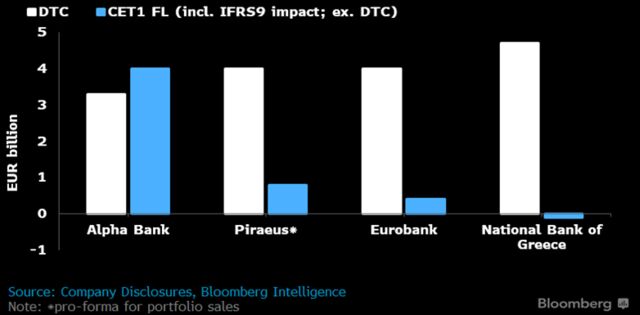
2. Greek Banks’ $18 Billion of DTC Could Form Bad Bank Backbone

Contributing Analysts Georgi Gunchev (Banks)

DTCs and Clean, Core Fully Loaded CET1

Confusion surrounding the structure, funding and capacity of a bad bank in Greece will likely remain even after details are presented on Nov. 22. A key concern will be where the buyers for debt issued by a special purpose vehicle will be sourced, with Italy, Ireland and Spain also working through legacy issues and absorbing investor capacity. As the graphic shows, deferred tax assets are a core part of transitional capital for the banks. With no likelihood of equity capital raises, any solution must avoid depleting their already scant core capital bases.

The mooted Bank of Greece plan is considerably more complicated and larger in scope than that of the Hellenic Financial Stability Fund, which is based on the Italian model and could relieve the banks of up to 15 billion euros of nonperforming exposure. (11/15/18)

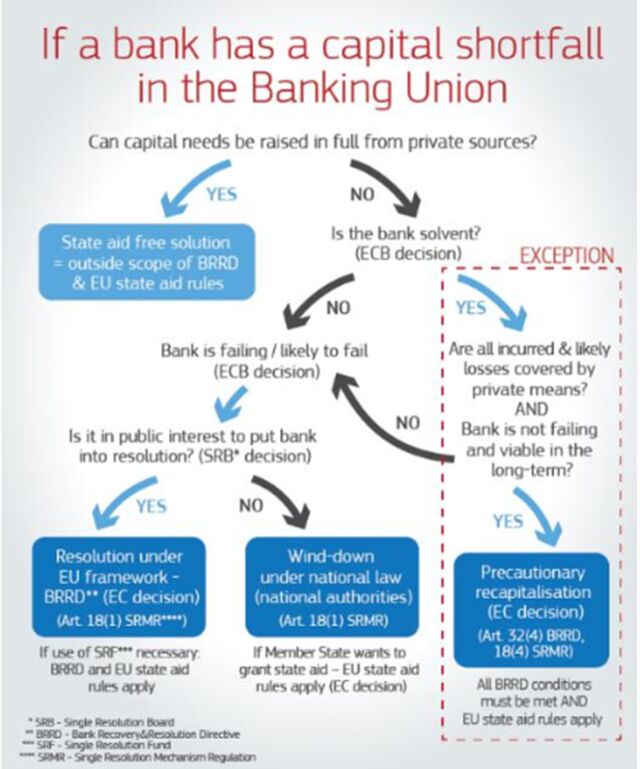
3. Greek Loophole Cleanup Is Nail in Bail-In Coffin

EU Bail-In Infographic

The new Greek cleanup plan could inflict a serious blow to the credibility of the EU bank resolution mechanism. The plan sees the transfer of convertible deferred tax assets (DTA) into an SPV as credit enhancement, which would help the sale of the senior issuance part of the vehicle destined to buy nonperforming loans. The recapitalization of equity reserves created by converting DTA could be achieved through issuance of common shares in favor of Greece. This could be met with skepticism if considered a side-step of the state-aid label.

One controversial precedent of bail-in rule use was the pre-emptive recapitalization of Monte Paschi by the Italian government. There the concern was the discretionary ECB positive opinion on bank solvency and long-term viability. This allowed state intervention rather than burden-sharing. (11/15/18)

4. Italian Banks Are Competition For Bad Debt Investors’ Dollars

Contributing Analysts Georgi Gunchev (Banks)

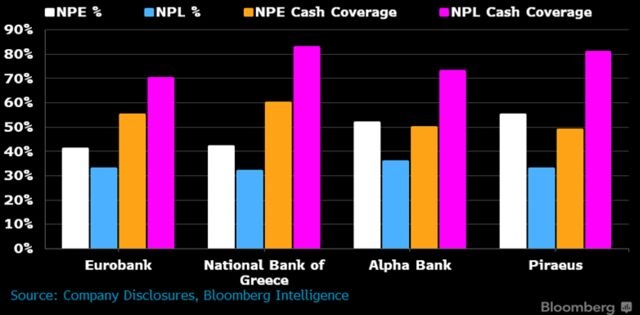
Greek Banks’ Coverage Level (%)

Cash coverage levels for the Greek banks ranged from 49% (Piraeus) to 60% (NBG) at 1H, with both Alpha and Eurobank within the low end of this range. This is in-line with Italy’s more beleaguered banks Banco BPM (51%), Carige (50%), Monte Paschi (56%) and CredEm (50%) which themselves are vying for investors to help offload their bad debt burdens. Curing of these NPEs will continue to be driven by corporate and SME segments, we believe, while the impact of the growing number of auctions on consumer behavior could accelerate organic outflows of NPEs.

Business loans represent two-thirds of Piraeus’ NPEs, with mortgages a little more than 20%. For Eurobank, mortgages (one-third) exceed corporate (30%) NPEs. Mortgages are larger (almost 50%) than SME and corporate combined for National Bank of Greece. (11/14/18)

5. Piraeus, Alpha Still Have Most to Do on Cleanup

Contributing Analysts Georgi Gunchev (Banks)

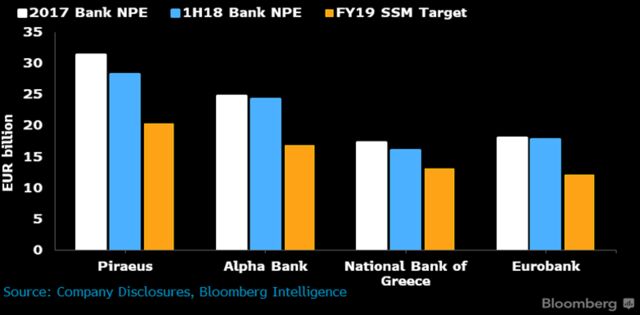
NPE Reduction vs. Targets

Piraeus bank remains the poster child for bad debt cleanup, with 28.5 billion euros of nonperforming exposures at 1H dwarfing less than 5 billion euros of fully-phased in CET1 capital (6.6 billion euros transitional). The approach taken to CET1 calculation, whether transitional — which the regulator will consider — or fully-loaded, which is a default for many investors, makes a significant difference. IFRS 9 and deferred tax assets — and the treatment thereof — are also significant deltas for each of the banks.

For Eurobank, the impact of transition to IFRS9 represented 250 bps of CET1 at 1H, effectively the difference between an 11.9% fully loaded ratio and 14.4% transitional. For Piraeus, the impact was increased 25% to 2 billion euros at 1H, highlighting the enormous sensitivity to accounting approach. (11/14/18)

6. Aggressive SSM Means 2021 Targets Will Be Tough

Contributing Analysts Georgi Gunchev (Banks)

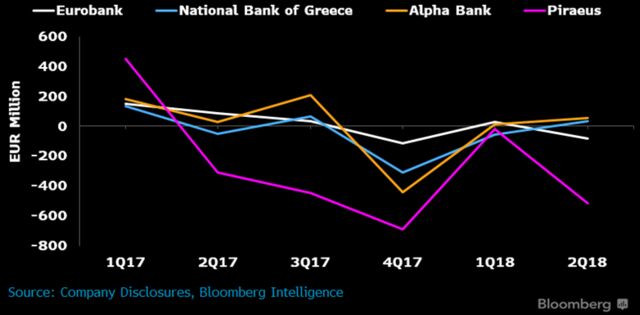
Domestic NPL Formation (Euros Million)

The rate of increase in restructurings and foreclosures, combined with a fall in non-performing exposure inflows, are together critical drivers of how quickly Greek banks’ bad-debt problems are addressed. Should third-party appetite for portfolio sales and securitizations dry up, the SSM will expect banks to absorb higher losses and writedowns, testing the resilience of already-limited cash coverage and fully loaded common equity tier-1 bases.

National Bank of Greece said on its 2Q call that it understood that the target set by the SSM for 2021 would be “aggressive” and as such, inorganic measures would be critical. The ability of banks to absorb further provisions to write off unprovisioned portions of NPEs also explains the need for a greater cost focus, to bolster their pre-provision operating-profit cushions. (09/10/18)

14
Νοέ

Greek Banks Inch Toward Bad-Loan Relief With Complicated Plans

Greek authorities are moving forward with two different plans to save their banks from a downward spiral. Some would-be investors think they’re too clever by half.

To reduce non-performing loans, the Greek central bank is proposing a special-purpose vehicle created with the stricken lenders’ tax credits — themselves an accounting creation of the nation’s past debt restructuring. With those assets, the SPV could effectively become a “bad bank,” selling bonds and acquiring some 42 billion euros ($47 billion) of bad loans, according to people with knowledge of the plan.

“We’re developing a plan in the Bank of Greece to use the deferred tax credit or claims of banks vis-a-vis the state,” Bank of Greece Governor Yannis Stournaras said at an event in Geneva, adding that Greece urgently needs a bad bank.

“It’s a highly complicated structured-finance transaction because it mixes complicated tax, legal and regulatory problems,” said Jerome Legras, head of research at Axiom Alternative Investments, a former veteran of Societe Generale SA’s structured-finance team. “It’s hard to see if there’s a genuine chance of having investors onboard.”

Read More: Greece Said to Weigh Freeing Banks of $47 Billion Debts

If that’s not enough complexity, one of the people said European regulators could approve both this plan and a parallel one floated last month by the state-owned Hellenic Financial Stability Fund. It envisaged an SPV partly funded by state cash and possibly involving a government guarantee. A similar plan in Italy has helped lenders offload a substantial amount of their soured debt.

Tax Challenges

The news was initially greeted with enthusiasm in Greece, which needs to unshackle its banks from the bad loan burden to help revive its economy. Bank stocks surged Tuesday — albeit off a low base, as they have been sinking for months.

“It is an interesting proposal,” Eurobank Chief Executive Officer Fokion Karavias told reporters Tuesday. “It would be another weapon in our armory.”

Piraeus Bank SA, down more than 60 percent this year, jumped as much as 7 percent before closing 1.8 percent higher. Eurobank Ergasias SA held its gains, closing 9 percent higher, but has still lost 28 percent in 2017.

“There are still missing parts to this initiative,” said Nick Koskoletos, head of research at Eurobank Equities. Still, “the mere fact that there are additional efforts to help jump-start the balance-sheet repair process could well be celebrated by the market,” he said.

However, the SPV faces daunting challenges, according to Legras. The deferred tax credit-fueled entity would probably need to seek a credit rating, and then investors in bonds issued by the SPV would need to study many complex tax implications.

‘Too Clever’

“I like complicated structured finance, but it seems weird to mix the two different risk profiles” of the deferred tax credits and the non-performing loans in one entity, he said. “My gut feeling is it’s a bit too clever.”

The Bank of Greece will release a detailed plan on Nov. 22, according to an official familiar with the matter. While the transfer of the tax credits to the SPV will deplete banks of some of their capital for a short period, their ratios will bounce back once the sale of the bad loans is completed, one of the officials said.

Another potential problem: It’s unclear if the plan would leave the banks with a sufficient buffer of capital, according to a person with knowledge of the matter.

“Would I buy those bonds? I undoubtedly would not, even for a hefty new issue premium,” said Timothee Pubellier, a portfolio manager at Financiere de La Cite in Paris who invests in debt linked to financial institutions. “What those banks need is fresh money. Moving imaginary capital will not improve their fundamental situation and won’t be convincing for investors.”

13
Νοέ

Greece Said to Weigh Freeing Banks From $47 Billion of Bad Debt

Greece Said to Weigh Freeing Banks From $47 Billion of Bad Debt

  • Central bank plan sees banks’ tax claim assets moving to SPV
  • Special vehicle will issue bonds, use proceeds to buy bad debt
By Christos Ziotis, Sotiris Nikas and Nikos Chrysoloras

(Bloomberg) — 

Greece’s central bank is working on a plan to help banks cut their bad debts in half, the latest effort to restore trust in the country’s financial system, two people familiar with the matter said.

Under the proposal, Greek lenders would transfer about half of their deferred tax claims to a special purpose vehicle, which will then sell bonds and use the proceeds to buy some 42 billion euros ($47 billion) of bad loans from the lenders, according to the people, who asked not to be named as the plan hasn’t been finalized yet.

The Greek lenders’ tax claims currently account for most of their capital. As claims against the state, they were granted to offset losses suffered during the country’s debt restructuring. It’s unclear whether investors would have an appetite for the bonds backed by these claims.

The Bank of Greece’s plan differs from a proposal floated by the Hellenic Financial Stability Fund earlier this year, which envisaged creating a vehicle partly funded by hard cash chipped in by the sovereign. The central bank has concerns that the HFSF’s proposal may have some drawbacks, while the money available would only suffice to unload some 15 billion euros of bad debt, much less than required.

Greek bank stocks have dropped by more than 40 percent this year amid lingering doubts that they can deal with a mountain of bad debt lingering from the steepest recession in living memory. Adding to their woes, European supervisors have asked them to reduce their non-performing exposures by about 60 percent by the end of 2021, a target that may not be achieved without burning more capital than they currently hold.

The Bank of Greece’s plan has been submitted to the European Central Bank’s Single Supervisory Mechanism and the Greek finance ministry, while any use of public guarantees is subject to approval by European Commission competition authorities. One of the people said that European regulators could approve both the Bank of Greece’s plan and that from the HFSF, giving lenders more tools to clean up their balance sheets.

While the transfer of the tax credits to the SPV will deplete banks of some of their capital for a short period, their ratios will bounce back once the sale of the bad loans is completed, one of the officials said. After several recapitalizations in recent years, common equity Tier one ratios at Greek banks currently range from about 14 percent to almost 19 percent.

The SPV would buy the bad loans from the banks at market prices, one of the officials said. While this may mean a further hit to their capital if the provisions the banks have taken are lower than the market prices, the blow would be small and manageable, while lenders would end up with higher quality capital, the person said, adding that supervisors have reviewed the numbers.


10
Νοέ

Μειώνονται οι εισφορές για 250.000 μη μισθωτούς

Νέο ασφαλιστικό τοπίο για 250.000 ελεύθερους επαγγελματίες, αυτοαπασχολουμένους και αγρότες διαμορφώνει από την 1η Ιανουαρίου 2019 το ασφαλιστικό σχέδιο νόμου, που πήρε τον δρόμο προς τη Βουλή. Πρόκειται για τη 2η νομοθετική παρέμβαση της κυβέρνησης, που περιέχει θετικές διατάξεις και αναμένεται να συζητηθεί και να ψηφιστεί με «πανηγυρικό» και προεκλογικό τόνο, όπως συνέβη και με τα αναδρομικά των ενστόλων και των ειδικών μισθολογίων. Με τα πρώτα 7 άρθρα του σχεδίου νόμου άλλωστε (από τα συνολικά 37), αλλάζει το σκηνικό των εισφορών για τους μη μισθωτούς, με εισόδημα πάνω από 7.032 ευρώ, καθώς οι εισφορές τους για κύρια ασφάλιση μειώνονται από 200 έως και 4.690 ευρώ τον χρόνο. Με άλλες διατάξεις του σχεδίου νόμου, ρυθμίζονται θέματα διοικητικού χαρακτήρα, προβλέπεται η αύξηση των τμημάτων του Σώματος Επιθεώρησης Εργασίας, δίνεται η δυνατότητα στον ΟΑΕΔ να καλύπτει το κόστος της δωρεάν μετακίνησης των ανέργων με τα μέσα μαζικής μεταφοράς μέσω ειδικών προγραμμάτων και εξομοιώνονται οι εργαζόμενοι στα δύο ελεγκτικά σώματα του υπουργείου Εργασίας, το ΣΕΠΕ και τα Περιφερειακά Ελεγκτικά Κέντρα Ασφάλισης (ΠΕΚΑ).

Αναλυτικά, από 1/1/2019 το ποσοστό της μηνιαίας ασφαλιστικής εισφοράς για τον κλάδο κύριας σύνταξης διαμορφώνεται από 20% σε 13,3% για τους πρώην ασφαλισμένους σε ΟΑΕΕ, ΕΤΑΑ και ΟΓΑ. Προσοχή όμως, όπως ορίζεται ρητά στο νομοσχέδιο που παρουσιάζει σήμερα η«Κ», η ελάχιστη μηνιαία εισφορά για τον συγκεκριμένο κλάδο δεν μπορεί να υπολείπεται του ποσού που αντιστοιχεί σε ποσοστό 20% επί του κατώτατου βασικού μισθού άγαμου μισθωτού άνω των 25 ετών (117,22 ευρώ).

Με αίτησή τους προς τον ΕΦΚΑ, οι ασφαλισμένοι θα μπορούν οποτεδήποτε να επιλέξουν ανώτερη βάση υπολογισμού των ποσοστιαίων εισφορών από εκείνη που προκύπτει βάσει του μηνιαίου εισοδήματός τους. Στην επιλογή του ασφαλισμένου, παραμένει και το χρονικό διάστημα κατά το οποίο θα εισφέρει αυξημένες εισφορές. Η εφαρμογή της νέας βάσης υπολογισμού αρχίζει από την πρώτη του επόμενου μήνα υποβολής της αίτησης και παύει να ισχύει αυτοδικαίως, οποτεδήποτε προκύψει ανώτερη βάση υπολογισμού βάσει του μηνιαίου εισοδήματος, καθώς και από τον επόμενο μήνα από την ανάκληση της αίτησης.

Ξεκαθαρίζεται, επίσης, πως αν ο ασφαλισμένος επιλέξει να καταβάλλει υψηλότερη εισφορά, δεν θα εφαρμόζονται οι εκπτώσεις 5% – 50% του νόμου Κατρούγκαλου για τους αυτοαπασχολουμένους του ΕΤΑΑ. Για τους λοιπούς, που θα καταβάλλουν την υποχρεωτική εισφορά, οι εκπτώσεις διατηρούνται ως έχουν σήμερα, δηλαδή επί του αθροίσματος των εισφορών για κύρια σύνταξη και για υγεία.

Για τους αυτοαπασχολουμένους του πρώην ΕΤΑΑ (άρθρο 2), από την 1η Ιανουαρίου 2019 καταργούνται οι εκπτώσεις που προβλέπονταν για την πρώτη 5ετία από την υπαγωγή τους στην ασφάλιση. Και αυτό, γιατί η μηνιαία εισφορά καθορίζεται επίσης στο 13,3%, ήτοι χαμηλότερα από τις μέχρι πρότινος προβλεπόμενες. Διατηρείται όμως η ελάχιστη μηνιαία βάση υπολογισμού στο 70% επί του εκάστοτε προβλεπόμενου κατώτατου βασικού μισθού. Προσοχή: Οι εκπτώσεις που ίσχυσαν τη διετία 2017-2018 εξακολουθούν να θεωρούνται ασφαλιστικές οφειλές και προβλέπεται η επιστροφή τους.

Τι ισχύει για αγρότες, η επικούρηση και η ρύθμιση χρεών

Το ύψος της μηνιαίας ασφαλιστικής εισφοράς για τους αγρότες (άρθρο 3) από την 1/1/2022 και μετά διαμορφώνεται σε 13,33% επί του εισοδήματός τους, όπως αυτό καθορίζεται με βάση το καθαρό φορολογητέο εισόδημα από την ασκούμενη αγροτική δραστηριότητα κατά το προηγούμενο φορολογικό έτος.

Στη μεταβατική περίοδο που ισχύει έως το 2022 οι εισφορές διαμορφώνονται σε 12% το 2019, 12,67% το 2020, 13% το 2021 και φθάνουν στο 13,3% το 2022. Το κατώτατο ασφαλιστέο μηνιαίο εισόδημα ορίζεται ως το ποσό που αναλογεί στο 70% του εκάστοτε προβλεπόμενου κατώτατου βασικού μισθού. Η ελάχιστη μηνιαία εισφορά για το 2019 δεν μπορεί να υπολείπεται του ποσού που αντιστοιχεί σε ποσοστό 18% επί του κατώτατου ασφαλιστέου μηνιαίου εισοδήματος, το 2020 δεν μπορεί να υπολείπεται του ποσού που αντιστοιχεί σε ποσοστό 19% επί του ορισθέντος κατώτατου ασφαλιστέου μηνιαίου εισοδήματος, το 2021 δεν μπορεί να υπολείπεται του ποσού που αντιστοιχεί σε ποσοστό 19,5% του κατώτατου ασφαλιστέου μηνιαίου εισοδήματος και από 1/1/2022 και μετά δεν μπορεί να υπολείπεται του ποσού που αντιστοιχεί σε ποσοστό 20% επί του ανωτέρω ορισθέντος κατώτατου ασφαλιστέου μηνιαίου εισοδήματος.

Οι εισφορές εφάπαξ και επικούρησης για τους μη μισθωτούς, επανακαθορίζονται αναδρομικά, από την 1/1/2017 ανεξαρτήτως εισοδήματος. Ειδικότερα, προβλέπεται ότι το ποσό της μηνιαίας εισφοράς στον κλάδο εφάπαξ παροχών ορίζεται σε ποσοστό 4% υπολογιζόμενο επί του 70% του εκάστοτε προβλεπόμενου κατώτατου βασικού μισθού άγαμου μισθωτού άνω των 25 ετών. Επίσης, προβλέπεται ότι το ποσό της μηνιαίας εισφοράς στον κλάδο επικουρικής ασφάλισης του ΕΤΕΑΕΠ ορίζεται έως τον Μάιο του 2019 σε ποσοστό 7%, από 1/6/2019 έως 31/5/2022 σε ποσοστό 6,5% και από 1/6/2022 και μετά σε ποσοστό 6%, υπολογιζόμενων όλων των ανωτέρω ποσοστών επί της ίδιας ως άνω μειωμένης βάσης υπολογισμού. Με άλλη διάταξη στο σχέδιο νόμου του υπουργείου Εργασίας προβλέπεται η ρύθμιση ληξιπρόθεσμων οφειλών, από το 2016 και μετά, των κλάδων υγείας των πρώην Ταμείων προς ασφαλισμένους, αλλά και γιατρούς και παρόχους. Η διαδικασία θα ισχύσει έως το τέλος του 2019 και προβλέπει 100% εξόφληση προς τους ασφαλισμένους-ασθενείς. Αντιθέτως, στους ιδιώτες και παρόχους προβλέπονται εκπτώσεις από 5% έως και 45%. Οφειλές προς παρόχους υπηρεσιών υγείας που εκκαθαρίζονται με τις διατάξεις της επίμαχης ρύθμισης συμψηφίζονται με τυχόν ληξιπρόθεσμες κάθε είδους οφειλές αυτών προς τον ΕΦΚΑ, πλην των ρυθμισμένων. Μάλιστα, όπως αναφέρεται, οι ληξιπρόθεσμες υποχρεώσεις της εν λόγω διάταξης εκκαθαρίζονται και πληρώνονται εξαιρετικά κατά παρέκκλιση των περί παραγραφής διατάξεων.

Πηγή: kathimerini.gr

8
Νοέ

Moscovici optimistic over Greece’s prospects

Moscovici optimistic over Greece’s prospects

EU Commissioner for Economic and Monetary Affairs Pierre Moscovici said on Thursday in a press conference that Greece has concluded the programmes and has turned a page.

He explained that sustainable development in the next years is feasible provided that reforms will continue and economic figures will not significantly change.

Fiscal surplus will be higher than estimated, he said, adding that negotiations are underway on how it could be used to boost growth.

Moscovici appeared relatively optimistic about the outlook growth of the Greek economy.

Source: ΑΠΕ-ΜΠΕ

Comodo SSL