Category: ΝΕΑ ΕΣΩΤΕΡΙΚΟΥ

18
Δεκ

Deutsche Bank: Τα μεγαλύτερα περιθώρια ανόδου στην Ευρώπη για τις ελληνικές τράπεζες


Αυξάνονται τα περιθώρια ανόδου για τις ελληνικές τράπεζες, σε σχέση με τις υπόλοιπες ευρωπαϊκές, σύμφωνα με τη νέα έκθεση της Deutsche Bank. Συγκεκριμένα, τα περιθώρια ανόδου των ελληνικών τραπεζών διαμορφώνονται έως και το 91% σε μέσο όρο, χωρίς να περιλαμβάνεται η μετοχή της Eurobank (λόγω του deal με την Grivalia).

Για τις υπόλοιπες τρεις ελληνικές τράπεζες μεμονωμένα, τα περιθώρια ανόδου διαμορφώνονται έως και το 135%.

Σε έκθεσή της με τίτλο Banks Monitor, η οποία «διαβάζει» τα αποτελέσματα των stress tests που πραγματοποίησε η Ευρωπαϊκή Αρχή Τραπεζών (EBA) στις ευρωπαϊκές τράπεζες, η Deutsche Bank παραθέτει τις εκτιμήσεις και τις αξιολογήσεις της για τις τραπεζικές μετοχές. Όπως εκτιμά η γερμανική τράπεζα, οι ελληνικές τράπεζες έχουν τα μεγαλύτερα περιθώρια ανόδου σε σχέση με όλες τις υπόλοιπες τράπεζες της περιοχής.

Την αμέσως μεγαλύτερη άνοδο μετά τις ελληνικές, προβλέπεται να έχουν οι ιταλικές τράπεζες (53% περιθώρια ανόδου), οι αυστριακές τράπεζες (51% περιθώρια ανόδου), οι γαλλικές (+50%) και οι βρετανικές (εκτός HSBC και Standard Chartered) με περιθώρια ανόδου 47%.

Αναλυτικά:

Alpha Bank: Σύσταση «buy», τιμή στόχο τα 2 ευρώ και περιθώρια ανόδου στο 61%. Σύμφωνα με τις εκτιμήσεις της Deutsche Bank, ο δείκτης p/e για το 2019 τοποθετείται στο 12,2 και για το 2020 στο 7,9, ενώ η λογιστική αξία στο 0,40 και τις δύο χρονιές.

Εθνική Τράπεζα: Σύσταση «buy», τιμή στόχο τα 2,7 ευρώ και περιθώρια ανόδου της τάξης του 135%. Οι δείκτες p/e εκτιμώνται στο 6,3 και το 3,9 το 2019 και το 2020 αντίστοιχα, ενώ η λογιστικά αξία στο 0,21 και το 0,20.

Τράπεζα Πειραιώς: Σύσταση «hold», τιμή στόχο τα 2,2 ευρώ και τα μεγαλύτερα περιθώρια ανόδου σε πανευρωπαϊκό επίπεδο, τα οποία τοποθετούνται στο 135%. Ο δείκτης p/e εκτιμάται στο 5,7 για το 2019 και στο 1,3 το 2020, ενώ η λογιστική αξία στο 0,08 και το 0,07 αντίστοιχα.

Σε ό,τι αφορά τις αποδόσεις ενσώματων ιδίων κεφαλαίων, για την Alpha Bank εκτιμώνται στο 0,1% το 2018, στο 2% το 2019 και στο 3% το 2020. Για την Εθνική, στο 1,6%, το 3,3% και το 5,2% αντίστοιχα και για την Πειραιώς στο -3,3%, το 1,3% και το 5,6%.

Αυξάνονται τα περιθώρια ανόδου για τις ελληνικές τράπεζες, σε σχέση με τις υπόλοιπες ευρωπαϊκές, σύμφωνα με τη νέα έκθεση της Deutsche Bank. Συγκεκριμένα, τα περιθώρια ανόδου των ελληνικών τραπεζών διαμορφώνονται έως και το 91% σε μέσο όρο, χωρίς να περιλαμβάνεται η μετοχή της Eurobank (λόγω του deal με την Grivalia).

Για τις υπόλοιπες τρεις ελληνικές τράπεζες μεμονωμένα, τα περιθώρια ανόδου διαμορφώνονται έως και το 135%.

Σε έκθεσή της με τίτλο Banks Monitor, η οποία «διαβάζει» τα αποτελέσματα των stress tests που πραγματοποίησε η Ευρωπαϊκή Αρχή Τραπεζών (EBA) στις ευρωπαϊκές τράπεζες, η Deutsche Bank παραθέτει τις εκτιμήσεις και τις αξιολογήσεις της για τις τραπεζικές μετοχές. Όπως εκτιμά η γερμανική τράπεζα, οι ελληνικές τράπεζες έχουν τα μεγαλύτερα περιθώρια ανόδου σε σχέση με όλες τις υπόλοιπες τράπεζες της περιοχής.

Την αμέσως μεγαλύτερη άνοδο μετά τις ελληνικές, προβλέπεται να έχουν οι ιταλικές τράπεζες (53% περιθώρια ανόδου), οι αυστριακές τράπεζες (51% περιθώρια ανόδου), οι γαλλικές (+50%) και οι βρετανικές (εκτός HSBC και Standard Chartered) με περιθώρια ανόδου 47%.

Αναλυτικά:

Alpha Bank: Σύσταση «buy», τιμή στόχο τα 2 ευρώ και περιθώρια ανόδου στο 61%. Σύμφωνα με τις εκτιμήσεις της Deutsche Bank, ο δείκτης p/e για το 2019 τοποθετείται στο 12,2 και για το 2020 στο 7,9, ενώ η λογιστική αξία στο 0,40 και τις δύο χρονιές.

Εθνική Τράπεζα: Σύσταση «buy», τιμή στόχο τα 2,7 ευρώ και περιθώρια ανόδου της τάξης του 135%. Οι δείκτες p/e εκτιμώνται στο 6,3 και το 3,9 το 2019 και το 2020 αντίστοιχα, ενώ η λογιστικά αξία στο 0,21 και το 0,20.

Τράπεζα Πειραιώς: Σύσταση «hold», τιμή στόχο τα 2,2 ευρώ και τα μεγαλύτερα περιθώρια ανόδου σε πανευρωπαϊκό επίπεδο, τα οποία τοποθετούνται στο 135%. Ο δείκτης p/e εκτιμάται στο 5,7 για το 2019 και στο 1,3 το 2020, ενώ η λογιστική αξία στο 0,08 και το 0,07 αντίστοιχα.

Σε ό,τι αφορά τις αποδόσεις ενσώματων ιδίων κεφαλαίων, για την Alpha Bank εκτιμώνται στο 0,1% το 2018, στο 2% το 2019 και στο 3% το 2020. Για την Εθνική, στο 1,6%, το 3,3% και το 5,2% αντίστοιχα και για την Πειραιώς στο -3,3%, το 1,3% και το 5,6%.


Πηγή: newmoney.gr

13
Δεκ

How to End Greece’s Banking Nightmare

If a country has a problem with its banks, the thing to do is to come up with a strategy and execute it swiftly. The trouble with Greece is that it has too many plans – and is taking too long to choose between them.

The Greek banking system is saddled with a very large number of non-performing loans, a legacy of protracted recession. Nearly half of all loans have gone sour, according to Bank of Greece data, and that’s only marginally less bad than the nadir of a year and a half ago.

The quality of the banks’ capital is also dubious. More than 50 percent of the combined capital of the country’s four biggest lenders is made up of deferred tax assets (discounts on future tax bills accumulated during years of losses). They’re struggling with profitability too: Return on equity is negative, as banks struggle with exceedingly high costs and a still depressed economy.

European supervisors seem to have turned a blind eye to what’s going on. Last spring, the European Central Bank cleared Greece’s four largest banks in a tailored stress test. The ECB’s Single Supervisory Mechanism – the region’s banking watchdog – has come up with a series of benchmarks for the reduction of bad loans, which the Greek lenders are broadly meeting. But investors are skeptical. Since the stress tests results were released, an index of the country’s bank stocks has lost almost half of its value.

Belatedly, the Greek authorities have decided to be more decisive. Unfortunately, they lack coordination. First, the Hellenic Financial Stability Fund – Greece’s bank rescue fund – proposed a plan to use government guarantees to ease the disposal of bundles of bad loans. Banks would securitize them, and the state would guarantee the safest tranche, increasing the number of potential investors. But then the Bank of Greece published a different strategy. This would involve the government letting the banks transfer their deferred tax assets to a special purpose vehicle. The SPV would then acquire up to 40 billion euros ($45 billion) in non-performing loans, cutting the amount in the system by nearly half.

It’s unclear whether either of these plans would by itself attract enough interest from investors. Most important, having two of them doesn’t give the impression of a country that’s picked which route to follow to address one of its chief economic problems. It would be much better to announce a single plan – which could combine elements of the aforementioned schemes – and then execute it. That might prompt investors to change their view on the sector.

While the government decides what to do, individual banks are going their own way. Eurobank Ergasias S.A. has announced a merger with Grivalia Properties REIC AE, a real estate investment company, which is expected to provide the combined entity with a chunky capital boost. Eurobank now plans to remove almost 7 billion euros of bad loans from its balance sheet, and is targeting a non-performing loan ratio of 15 percent by the end of 2019. This is by far the most promising thing that’s happened to the Greek banking system this year. But it may be hard to replicate, since it relies on the existence of a company willing to be taken over. It helped too that Grivalia and Eurobank have a large shareholder in common.

So long as Greece’s authorities fail to find a common solution to their lenders’ woes, even clever plans like Eurobank’s may not be enough. It’s hard to see how Greece can bounce back strongly after such a long recession with a still-crippled banking system. Athens needs a plan, not a multitude of ideas.

11
Δεκ

Σε υψηλά 10ετίας η αγορά εργασίας.Ποιοι κλάδοι κάνουν προσλήψεις τώρα στην Ελλάδα

Οι Έλληνες εργοδότες αναμένουν σταθερά ανοδικές προθέσεις προσλήψεων για το επόμενο τρίμηνο, σύμφωνα με την Έρευνα για τις Προθέσεις Προσλήψεων της ManpowerGroup, όπως ανακοινώθηκε σήμερα από τη ManpowerGroup Ελλάδας.

Σε συνέχεια της εποχικής προσαρμογής των δεδομένων, οι Συνολικές Προοπτικές Απασχόλησης ανέρχονται σε +18%, φτάνοντας στο υψηλότερο επίπεδο που έχει καταγραφεί εδώ και 10 και πλέον χρόνια. Τα σχέδια προσλήψεων διατηρούνται σχετικά σταθερά σε σύγκριση με το προηγούμενο τρίμηνο και βελτιώνονται κατά 5 ποσοστιαίες μονάδες σε σχέση με το αντίστοιχο τρίμηνο του προηγούμενου έτους.

“Μετά από ένα πολύ μεγάλο χρονικό διάστημα, η χώρα φαίνεται να μπαίνει σε μια πιο ισχυρή και σταθερή φάση ανάκαμψης. Οι τομείς των Χρηματοοικονομικών, Ασφαλειών, Ακίνητης Περιουσίας και Παροχής Υπηρεσιών προς Επιχειρήσεις συνεχίζουν να είναι ανάμεσα στους πιο αναπτυσσόμενους τομείς, ενώ παράλληλα ο Δημόσιος Τομέας δείχνει σημάδια ανάπτυξης εντός του επόμενου 3μήνου. Βάσει των στοιχείων που έχουμε από τους πελάτες μας, οι προσλήψεις στο προσεχές 3μηνο θα κινηθούν περίπου στα ίδια επίπεδα με το προηγούμενο, με τη μεγαλύτερη ζήτηση να υπάρχει για θέσεις πωλήσεων και εξυπηρέτησης”, δηλώνει ο κος Μπάμπης Καζαντζίδης, Γενικός Εμπορικός Διευθυντής της ManpowerGroup Ελλάδας.

Συγκρίσεις ανά Τομέα Οικονομικής Δραστηριότητας

Οι εργοδότες και στους εννέα τομείς οικονομικής δραστηριότητας αναμένουν να αυξήσουν τον αριθμό των ατόμων που απασχολούν έως το τέλος του Α’ Τριμήνου του 2019. Οι εργοδότες στον τομέα των Χρηματοοικονομικών, Ασφαλειών, Ακίνητης Περιουσίας και Παροχής Υπηρεσιών προς Επιχειρήσεις αναφέρουν τις ισχυρότερες προθέσεις προσλήψεων, με Συνολικές Προοπτικές Απασχόλησης της τάξης του +21%, ενώ αισιόδοξες Προοπτικές, της τάξης του +19%, καταγράφονται και για τον Δημόσιο Τομέα και τις Κοινωνικές Υπηρεσίες.

Σταθερές αυξήσεις του αριθμού των απασχολουμένων αναμένονται και στον τομέα του Εμπορίου (Χονδρική & Λιανική), με Προοπτικές της τάξης του +18%, και σε δύο ακόμη τομείς με Προοπτικές της τάξης του +17%, τον τομέα της Γεωργίας και τον τομέα των Μεταφορών & Επικοινωνιών. Παράλληλα, οι εργοδότες του τομέα Ηλεκτρισμού, Φυσικού Αερίου & Ύδρευσης καταγράφουν τις πιο αδύναμες προοπτικές απασχόλησης, με Προοπτικές της τάξης του +7%.

Σε σύγκριση με το προηγούμενο τρίμηνο, οι προθέσεις προσλήψεων αποδυναμώνονται σε πέντε από τους εννέα τομείς οικονομικής δραστηριότητας, με σημαντικότερη μείωση τις 12 ποσοστιαίες μονάδες στον τομέα Ηλεκτρισμού, Φυσικού Αερίου & Ύδρευσης και τις 3 ποσοστιαίες μονάδες στον τομέα του Εμπορίου (Χονδρική & Λιανική). Ωστόσο, οι Προοπτικές ενισχύονται σε τέσσερις τομείς, συμπεριλαμβανομένου και του τομέα της Γεωργίας, αλλά και του Δημόσιου Τομέα & Κοινωνικών Υπηρεσιών, όπου οι εργοδότες αναφέρουν αυξήσεις της τάξης των 12 και 3 ποσοστιαίων μονάδων, αντίστοιχα.

Τα σχέδια προσλήψεων ενισχύονται σε επτά από τους εννέα τομείς οικονομικής δραστηριότητας σε σύγκριση με το αντίστοιχο τρίμηνο του προηγούμενου έτους. Οι σημαντικότερες βελτιώσεις, της τάξης των 9 ποσοστιαίων μονάδων, καταγράφονται στους τομείς Χρηματοοικονομικών, Ασφαλειών, Ακίνητης Περιουσίας και Παροχής Υπηρεσιών προς Επιχειρήσεις και Τουρισμού. Οι εργοδότες του τομέα των Κατασκευών καταγράφουν βελτίωση 8 ποσοστιαίων μονάδων, και οι Προοπτικές εμφανίζονται ενισχυμένες κατά 7 ποσοστιαίες μονάδες στον τομέα του Εμπορίου (Χονδρική & Λιανική). Παράλληλα, οι Προοπτικές αποδυναμώνονται σε δύο τομείς, κατά 12 και 4 ποσοστιαίες μονάδες στον τομέα Ηλεκτρισμού, Φυσικού Αερίου & Ύδρευσης και τον τομέα των Μεταφορών & Επικοινωνιών, αντίστοιχα.

Συγκρίσεις ανά μέγεθος οργανισμού

Αναμένονται αυξήσεις του αριθμού των θέσεων εργασίας και στις τέσσερις κατηγορίες μεγέθους οργανισμού κατά το προσεχές τρίμηνο. Οι εργοδότες τόσο στις Μεγάλου όσο και στις Μεσαίου μεγέθους επιχειρήσεις αναφέρουν αισιόδοξες προθέσεις προσλήψεων, με Συνολικές Προοπτικές Απασχόλησης της τάξης του +28% και +25%, αντίστοιχα. Παράλληλα, οι εργοδότες στις Μικρές επιχειρήσεις αναμένουν σταθερή αύξηση του αριθμού των απασχολουμένων, καταγράφοντας Προοπτικές της τάξης του +17%, ενώ οι Προοπτικές για τις Πολύ Μικρές επιχειρήσεις καταγράφονται στο +9%.

Σε σύγκριση με το τελευταίο τρίμηνο του 2018, οι εργοδότες στις Μεσαίες επιχειρήσεις αναφέρουν βελτίωση της τάξης των 6 ποσοστιαίων μονάδων, αλλά οι Προοπτικές για Μεγάλες επιχειρήσεις μειώνονται αντίστοιχα κατά 6 ποσοστιαίες μονάδες. Οι εργοδότες στις Πολύ Μικρές και Μικρές επιχειρήσεις αναφέρουν σχετικά σταθερά σχέδια προσλήψεων.

Σε σύγκριση με το αντίστοιχο περσινό διάστημα, οι Προοπτικές για τους εργοδότες των Μεσαίων επιχειρήσεων βελτιώνονται σημαντικά, κατά 11 ποσοστιαίες μονάδες, ενώ οι Προοπτικές εμφανίζονται ενισχυμένες κατά 5 ποσοστιαίες μονάδες τόσο στις Πολύ Μικρές όσο και στις Μικρές επιχειρήσεις. Ωστόσο, οι εργοδότες στις Μεγάλες επιχειρήσεις καταγράφουν μείωση της τάξης των 2 ποσοστιαίων μονάδων.

Πηγή: euro2day.gr

<

11
Δεκ

Manpower: Το 19% των εργοδοτών προβλέπει αύξηση του αριθμού των απασχολούμενων για τους επόμενους 3 μήνες

Οι Έλληνες εργοδότες αναμένουν σταθερά ανοδικές προθέσεις προσλήψεων για το επόμενο τρίμηνο, σύμφωνα με την Έρευνα για τις Προθέσεις Προσλήψεων της ManpowerGroup, όπως ανακοινώθηκε σήμερα από τη ManpowerGroup Ελλάδας.

Ειδικότερα, σύμφωνα με σχετική ανακοίνωση, σε συνέχεια της εποχικής προσαρμογής των δεδομένων, οι Συνολικές Προοπτικές Απασχόλησης ανέρχονται σε +18%, φτάνοντας στο υψηλότερο επίπεδο που έχει καταγραφεί εδώ και 10 και πλέον χρόνια. Τα σχέδια προσλήψεων διατηρούνται σχετικά σταθερά σε σύγκριση με το προηγούμενο τρίμηνο και βελτιώνονται κατά 5 ποσοστιαίες μονάδες σε σχέση με το αντίστοιχο τρίμηνο του προηγούμενου έτους.

“Μετά από ένα πολύ μεγάλο χρονικό διάστημα, η χώρα φαίνεται να μπαίνει σε μια πιο ισχυρή και σταθερή φάση ανάκαμψης. Οι τομείς των Χρηματοοικονομικών, Ασφαλειών, Ακίνητης Περιουσίας και Παροχής Υπηρεσιών προς Επιχειρήσεις συνεχίζουν να είναι ανάμεσα στους πιο αναπτυσσόμενους τομείς, ενώ παράλληλα ο Δημόσιος Τομέας δείχνει σημάδια ανάπτυξης εντός του επόμενου 3μήνου. Βάσει των στοιχείων που έχουμε από τους πελάτες μας, οι προσλήψεις στο προσεχές 3μηνο θα κινηθούν περίπου στα ίδια επίπεδα με το προηγούμενο, με τη μεγαλύτερη ζήτηση να υπάρχει για θέσεις πωλήσεων και εξυπηρέτησης”, δηλώνει ο κος Μπάμπης Καζαντζίδης, Γενικός Εμπορικός Διευθυντής της ManpowerGroup Ελλάδας.

Αναλυτικά: Συγκρίσεις ανά Τομέα Οικονομικής Δραστηριότητας

Οι εργοδότες και στους εννέα τομείς οικονομικής δραστηριότητας αναμένουν να αυξήσουν τον αριθμό των ατόμων που απασχολούν έως το τέλος του Α’ Τριμήνου του 2019. Οι εργοδότες στον τομέα των Χρηματοοικονομικών, Ασφαλειών, Ακίνητης Περιουσίας και Παροχής Υπηρεσιών προς Επιχειρήσεις αναφέρουν τις ισχυρότερες προθέσεις προσλήψεων, με Συνολικές Προοπτικές Απασχόλησης της τάξης του +21%, ενώ αισιόδοξες Προοπτικές, της τάξης του +19%, καταγράφονται και για τον Δημόσιο Τομέα και τις Κοινωνικές Υπηρεσίες. Σταθερές αυξήσεις του αριθμού των απασχολουμένων αναμένονται και στον τομέα του Εμπορίου (Χονδρική & Λιανική), με Προοπτικές της τάξης του +18%, και σε δύο ακόμη τομείς με Προοπτικές της τάξης του +17%, τον τομέα της Γεωργίας και τον τομέα των Μεταφορών & Επικοινωνιών. Παράλληλα, οι εργοδότες του τομέα Ηλεκτρισμού, Φυσικού Αερίου & Ύδρευσης καταγράφουν τις πιο αδύναμες προοπτικές απασχόλησης, με Προοπτικές της τάξης του +7%.

Σε σύγκριση με το προηγούμενο τρίμηνο, οι προθέσεις προσλήψεων αποδυναμώνονται σε πέντε από τους εννέα τομείς οικονομικής δραστηριότητας, με σημαντικότερη μείωση τις 12 ποσοστιαίες μονάδες στον τομέα Ηλεκτρισμού, Φυσικού Αερίου & Ύδρευσης και τις 3 ποσοστιαίες μονάδες στον τομέα του Εμπορίου (Χονδρική & Λιανική). Ωστόσο, οι Προοπτικές ενισχύονται σε τέσσερις τομείς, συμπεριλαμβανομένου και του τομέα της Γεωργίας, αλλά και του Δημόσιου Τομέα & Κοινωνικών Υπηρεσιών, όπου οι εργοδότες αναφέρουν αυξήσεις της τάξης των 12 και 3 ποσοστιαίων μονάδων, αντίστοιχα.

Τα σχέδια προσλήψεων ενισχύονται σε επτά από τους εννέα τομείς οικονομικής δραστηριότητας σε σύγκριση με το αντίστοιχο τρίμηνο του προηγούμενου έτους. Οι σημαντικότερες βελτιώσεις, της τάξης των 9 ποσοστιαίων μονάδων, καταγράφονται στους τομείς Χρηματοοικονομικών, Ασφαλειών, Ακίνητης Περιουσίας και Παροχής Υπηρεσιών προς Επιχειρήσεις και Τουρισμού. Οι εργοδότες του τομέα των Κατασκευών καταγράφουν βελτίωση 8 ποσοστιαίων μονάδων, και οι Προοπτικές εμφανίζονται ενισχυμένες κατά 7 ποσοστιαίες μονάδες στον τομέα του Εμπορίου (Χονδρική & Λιανική). Παράλληλα, οι Προοπτικές αποδυναμώνονται σε δύο τομείς, κατά 12 και 4 ποσοστιαίες μονάδες στον τομέα Ηλεκτρισμού, Φυσικού Αερίου & Ύδρευσης και τον τομέα των Μεταφορών & Επικοινωνιών, αντίστοιχα.

Συγκρίσεις ανά μέγεθος οργανισμού

Αναμένονται αυξήσεις του αριθμού των θέσεων εργασίας και στις τέσσερις κατηγορίες μεγέθους οργανισμού κατά το προσεχές τρίμηνο. Οι εργοδότες τόσο στις Μεγάλου όσο και στις Μεσαίου μεγέθους επιχειρήσεις αναφέρουν αισιόδοξες προθέσεις προσλήψεων, με Συνολικές Προοπτικές Απασχόλησης της τάξης του +28% και +25%, αντίστοιχα. Παράλληλα, οι εργοδότες στις Μικρές επιχειρήσεις αναμένουν σταθερή αύξηση του αριθμού των απασχολουμένων, καταγράφοντας Προοπτικές της τάξης του +17%, ενώ οι Προοπτικές για τις Πολύ Μικρές επιχειρήσεις καταγράφονται στο +9%.

inRead Advertisement by VIDADS since 2011

Σε σύγκριση με το τελευταίο τρίμηνο του 2018, οι εργοδότες στις Μεσαίες επιχειρήσεις αναφέρουν βελτίωση της τάξης των 6 ποσοστιαίων μονάδων, αλλά οι Προοπτικές για Μεγάλες επιχειρήσεις μειώνονται αντίστοιχα κατά 6 ποσοστιαίες μονάδες. Οι εργοδότες στις Πολύ Μικρές και Μικρές επιχειρήσεις αναφέρουν σχετικά σταθερά σχέδια προσλήψεων.

Σε σύγκριση με το αντίστοιχο περσινό διάστημα, οι Προοπτικές για τους εργοδότες των Μεσαίων επιχειρήσεων βελτιώνονται σημαντικά, κατά 11 ποσοστιαίες μονάδες, ενώ οι Προοπτικές εμφανίζονται ενισχυμένες κατά 5 ποσοστιαίες μονάδες τόσο στις Πολύ Μικρές όσο και στις Μικρές επιχειρήσεις. Ωστόσο, οι εργοδότες στις Μεγάλες επιχειρήσεις καταγράφουν μείωση της τάξης των 2 ποσοστιαίων μονάδων.

Διεθνείς Συγκρίσεις 

Περισσότεροι από 60.000 εργοδότες σε 44 χώρες και επικράτειες συμμετείχαν στην έρευνα της ManpowerGroup για τη σφυγμομέτρηση της αναμενόμενης δραστηριότητας στην αγορά εργασίας* κατά το διάστημα από τον Ιανουάριο έως και τον Μάρτιο του 2019. Όλοι οι συμμετέχοντες απάντησαν στην εξής ερώτηση: “Ποια πιστεύετε ότι θα είναι η μεταβολή στο συνολικό αριθμό των ατόμων που απασχολούνται στον οργανισμό σας, στην περιοχή ευθύνης σας, κατά τους τρεις επόμενους μήνες, μέχρι και το τέλος Μαρτίου 2019, σε σχέση με το τρέχον τρίμηνο;”

Η έρευνα της ManpowerGroup για το πρώτο τρίμηνο του 2019 αποκαλύπτει ότι αναμένεται αύξηση του αριθμού των απασχολουμένων σε 43 από τις 44 χώρες και επικράτειες στο διάστημα έως και το τέλος Μαρτίου.

Οι προθέσεις προσλήψεων κατά το προσεχές τρίμηνο εμφανίζονται ενισχυμένες σε 16 από τις 44 χώρες και επικράτειες σε σύγκριση με το προηγούμενο τρίμηνο, αποδυναμωμένες σε 23, και αμετάβλητες σε πέντε. Σε σύγκριση με το αντίστοιχο διάστημα του προηγούμενου έτους, οι Προοπτικές βελτιώνονται σε 21 χώρες και επικράτειες, επιδεινώνονται σε 20, και παραμένουν αμετάβλητες σε δύο**. Η αυτοπεποίθηση των εργοδοτών αναφορικά με τις προσλήψεις κατά το πρώτο τρίμηνο είναι ισχυρότερη στην Ιαπωνία, την Ταϊβάν, τις ΗΠΑ, τη Σλοβενία, την Ελλάδα και το Χονγκ Κονγκ, ενώ οι εργοδότες σε Αργεντινή, Ελβετία, Ιταλία, Παναμά και Ισπανία αναφέρουν τις πιο αδύναμες προθέσεις προσλήψεων.

Αύξηση του αριθμού των απασχολουμένων αναμένεται κατά το πρώτο τρίμηνο του 2019, και στις 26 χώρες της περιφέρειας Ευρώπη, Μέση Ανατολή & Αφρική (ΕΜΕΑ) που συμμετέχουν στην Έρευνα. Σε σύγκριση με το προηγούμενο τρίμηνο, οι εργοδότες σε οκτώ χώρες καταγράφουν ενισχυμένες προοπτικές προσλήψεων, ενώ σε 15 τα σχέδια προσλήψεων εμφανίζονται αποδυναμωμένα. Σε σύγκριση με το αντίστοιχο διάστημα του προηγούμενου έτους, οι προβλέψεις ενισχύονται σε 12 χώρες αλλά αποδυναμώνονται σε 13. Οι ισχυρότερες αγορές εργασίας στην περιφέρεια ΕΜΕΑ για το προσεχές τρίμηνο, καταγράφονται στη Σλοβενία και την Ελλάδα, ενώ οι Ελβετοί εργοδότες αναφέρουν τα πιο αδύναμα σχέδια προσλήψεων.

Οι εργοδότες και στις οκτώ χώρες και επικράτειες της Ασίας-Ωκεανίας προτίθενται να αυξήσουν τον αριθμό των ατόμων που απασχολούν κατά το προσεχές τρίμηνο. Σε σύγκριση με το προηγούμενο τρίμηνο, οι προβλέψεις ενισχύονται σε τέσσερις χώρες και επικράτειες αλλά αποδυναμώνονται σε δύο. Σε σύγκριση με το αντίστοιχο διάστημα του προηγούμενου έτους, οι εργοδότες σε πέντε χώρες και επικράτειες καταγράφουν ενισχυμένες προοπτικές προσλήψεων, ενώ αποδυναμωμένες Προοπτικές καταγράφονται σε δύο. Οι εργοδότες σε Ιαπωνία και Ταϊβάν αναφέρουν τις ισχυρότερες προθέσεις προσλήψεων στην περιφέρεια, ενώ οι πιο αδύναμες Προοπτικές καταγράφονται σε Κίνα και Σιγκαπούρη.

Ο αριθμός των απασχολουμένων αναμένεται να αυξηθεί σε εννέα από τις 10 χώρες της Βόρειας, Νότιας και Κεντρικής Αμερικής που συμμετέχουν στην έρευνα κατά το διάστημα από τον Ιανουάριο έως και τον Μάρτιο, αλλά οι εργοδότες σε μία χώρα – την Αργεντινή – αναμένουν μείωση του αριθμού των ατόμων που απασχολούν. Οι προοπτικές προσλήψεων ενισχύονται σε τέσσερις χώρες της Βόρειας, Νότιας και Κεντρικής Αμερικής σε σύγκριση με το τελευταίο τρίμηνο του 2018, αλλά αποδυναμώνονται σε έξι. Σε σύγκριση με το αντίστοιχο διάστημα του προηγούμενου έτους, οι Προοπτικές βελτιώνονται σε τέσσερις χώρες αλλά επιδεινώνονται σε πέντε. Τα πιο αισιόδοξα σχέδια προσλήψεων πρώτου τριμήνου καταγράφονται στις ΗΠΑ και το Μεξικό, ενώ οι εργοδότες στην Αργεντινή και τον Παναμά αναφέρουν τις πιο αδύναμες προβλέψεις της περιφέρειας.

 

Πηγή: capital.gr

7
Δεκ

Greece Drags Itself Back Toward Normality

As the cradle of democracy, Greece knows better than most countries what politics is all about. Yet, for the last eight years, any discussions between lawmakers from the left and right there have been overshadowed by the country’s economic collapse, and the string of rescue programs put together by the European Union and International Monetary Fund.

Athens has been locked in permanent confrontation with its European partners, which culminated in the showdown of 2015 when Greece very nearly exited the euro after a dramatic referendum. Politicians of every persuasion had little room for maneuver, as economic policy was dictated by the “memoranda of understanding” with its financial rescuers, who imposed budget consolidation and structural reforms.

Greece left its third adjustment program in August, and it’s refreshing to feel a hint of a return to politics as usual ahead of next year’s general election. Politicians have largely stopped blaming Brussels, and seem more focused on what they might do for voters. The confrontation between Syriza, the left-wing governing party, and New Democracy, the center-right opposition that’s leading in the polls, is fierce. But it offers the impression of a country that’s longing for normality.

An improving economy helps. Greece’s gross domestic product is on course to expand by about 2 percent this year as exports start to pick up. Unemployment has finally fallen below 20 percent after peaking at nearly 30 percent in 2013. Of course, many companies remain reluctant to invest because of high taxes and a deteriorating business environment. Poverty levels remain intolerable. But there is a slight break from the endless woes — some self-inflicted — that marred the Greek economy for most of this decade.

The fiscal outlook is brighter too. Greek national debt still stands at nearly 180 percent of GDP. But the country is meeting the targets demanded by its creditors. The primary surplus in the first 10 months of this year stood at nearly 6.5 billion euros ($7.4 billion). That gives the government room to avoid more cuts and raise discretionary spending.

The political debate has shifted. Both Syriza and New Democracy now accept that Greece needs the confidence of its European partners and international investors. Brussels and Berlin are still blamed for deepening the crisis, but that’s no longer the main focus of Greek politicians. Their eyes are set on next year’s general election: a political battle that might define Greece’s economic model for years to come.

Alexis Tsipras, the prime minister who took Greece to the brink of a euro exit and then back, believes it’s time to help those left behind during the recession. Syriza pays lip service to helping companies, flouting a corporate tax cut from 29 percent to 25 percent over the next four years. But the party’s main interest lies elsewhere. It wants to beef up the public sector by hiring more workers in education and local government; restore collective wage bargaining; and increase the minimum wage, pensions and social benefits.

The priorities of Kyriakos Mitsotakis, New Democracy’s leader, are radically different. The Harvard-educated businessman wants spending cuts to help him fund a generous tax reduction. He would outsource public services, while slashing corporation tax to 20 percent. He also wants to overhaul pensions, strengthening private provision.

Syriza politicians dismiss New Democracy as “neoliberal” and incapable of repairing Greece’s torn social fabric. But they have a very sketchy record to defend. The last recession was largely self-caused, as Tsipras and his then finance minister Yanis Varoufakis insisted on confronting creditors. Greece has lost out on some of the best years of the European recovery. The comparison with Portugal — which grew by more than 12 percent between 2014 and 2017, while Greece stagnated — is brutal.

Domestic investors are desperate for change. Some moved to Bulgaria and Cyprus, attracted by lower taxes. Others point to the lack of progress on reform, as well as the attack on independent institutions such as the Bank of Greece. But for all New Democracy’s appeal to the richer classes, Syriza’s message still resonates with the poor. The incipient economic recovery could help Tsipras.

The country still faces formidable challenges, which will make governing hard for whoever has power. Nearly half the loans in the banking system are nonperforming, and bank shares have lost almost 50 percent of their value this year. The global economic slowdown could turn into recession by the time a new government came to power. That would make it much harder to maintain the promised primary surpluses and could create new tensions with the EU. Productivity is still well below pre-recession levels, as the brain drain sucks talent out of the country. Domestic consumption remains sluggish, after a dramatic drop in living standards.

But at least Greece appears ready to take its destiny back into its own hands. While this won’t be enough to succeed, any signs of hope are welcome.

3
Δεκ

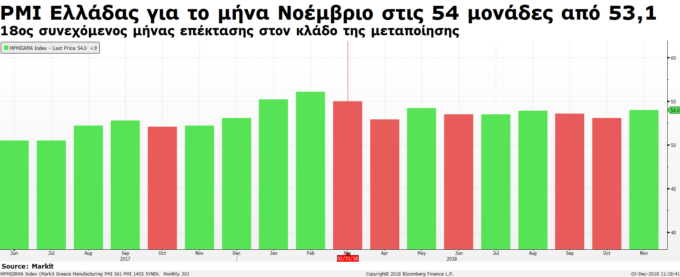
Μεταποίηση: 18ος συνεχόμενος μήνας επέκτασης στην Ελλάδα, ναδίρ άνω των δύο ετών στην Ευρωζώνη

Ο ελληνικός μεταποιητικός κλάδος παρέμεινε σε τροχιά ανάκαμψης τον Νοέμβριο, βελτιώνοντας τα επίπεδα παραγωγής και απασχόλησης, αν και η ζήτηση από το εξωτερικό ήταν η μικρότερη των τελευταίων 14 μηνών. Ο παράγοντας αυτός φαίνεται να είναι το μεγάλο βαρίδι συνολικά στην μεταποιητική δραστηριότητα της Ευρωζώνης, η οποία αναπτύσσεται μεν, αλλά παρουσιάζει τις χειρότερες επιδόσεις από τον Αύγουστο του 2016.

Σύμφωνα με την μηνιαία έρευνα της IHS Markit ο δείκτης PMI για την ελληνική μεταποίηση σκαρφάλωσε από τις 53,1 μονάδες τον Οκτώβριο στις 54 τον Νοέμβριο- τα υψηλότερα επίπεδα εδώ και έξι μήνες.

Η αύξηση της παραγωγής ήταν, σε γενικές γραμμές, ισχυρή και συνδέθηκε ιδιαιτέρως με τον μεγαλύτερο όγκο νέων παραγγελιών και την εντονότερη ζήτηση των πελατών. Οι νέες παραγγελίες αυξήθηκαν με τον ισχυρότερο ρυθμό που έχει καταγραφεί από τον Μάρτιο, με την άνοδο να αποδίδεται στην εγχώρια ζήτηση. Οι νέες εργασίες από το εξωτερικό αυξήθηκαν με το βραδύτερο ρυθμό από το Σεπτέμβριο του 2017.

Ιδιαίτερα ενθαρρυντικά τα μηνύματα από το μέτωπο της απασχόλησης, με τον ρυθμό δημιουργίας θέσεων εργασίας να είναι ένας από τους ταχύτερους που έχουν καταγραφεί από την αρχή συλλογής των στοιχείων της έρευνας, το 1999.

Την ίδια ώρα ο δείκτης PMI για τη μεταποίηση στην Ευρωζώνη διολίσθησε από τις 52 μονάδες τον Οκτώβριο σε μόλις 51,8μονάδες. Πρόκειται για τον τρίτο διαδοχικό μήνα πτώσης και την πλέον απογοητευτική επίδοση εδώ και περισσότερο από δύο χρόνια. Υπενθυμίζεται ότι οι 50 μονάδες είναι το όριο, που διακρίνει την ανάπτυξη από την ύφεση.

Όσο για τον επιμέρους δείκτη της παραγωγής «βούτηξε» από τις 51,3 στις 50,7 μονάδες, τα χαμηλότερα επίπεδα από τα μέσα του 2013.

Πηγή: naftemporiki.gr

1
Δεκ

Αυξήθηκε ο τζίρος στο λιανεμπόριο για έβδομο συνεχή μήνα

Με άνοδο για έβδομο συνεχή μήνα και παρά την εντύπωση που επικρατεί στον εμπορικό κόσμο έκλεισε ο Σεπτέμβριος για τον τζίρο στο λιανικό εμπόριο. Σύμφωνα με τα στοιχεία που ανακοίνωσε, χθες, η Ελληνική Στατιστική Αρχή (ΕΛΣΤΑΤ), ο γενικός δείκτης κύκλου εργασιών στο λιανεμπόριο αυξήθηκε τον Σεπτέμβριο του 2018 κατά 4,9% σε σύγκριση με τον Σεπτέμβριο του 2017, ενώ μικρότερη ήταν η αύξηση του γενικού δείκτη όγκου (κύκλος εργασιών σε σταθερές τιμές), κατά 3,3% σε ετήσια βάση.

Η απόκλιση αυτή οφείλεται κυρίως στην αύξηση των τιμών των καυσίμων φέτος σε σύγκριση με πέρυσι, κάτι που φαίνεται από την ανάλυση της μεταβολής του τζίρου στις επιμέρους κατηγορίες εμπορικών καταστημάτων. Σύμφωνα, λοιπόν, με την ΕΛΣΤΑΤ ο δείκτης κύκλου εργασιών στα πρατήρια καυσίμων αυξήθηκε τον Σεπτέμβριο του 2018 σε σύγκριση με τον Σεπτέμβριο του 2017 κατά 10,3%. Ωστόσο, ο δείκτης όγκου στην ίδια κατηγορία στα πρατήρια καυσίμων κατέγραψε αύξηση μόλις 1%. Με άλλα λόγια, η μεγάλη αύξηση του τζίρου προήλθε κατά κύριο λόγο από τις ανατιμήσεις στα καύσιμα.

Αύξηση της αξίας πωλήσεων 6,8% καταγράφηκε τον Σεπτέμβριο του 2018 σε σύγκριση με έναν χρόνο πριν στα μεγάλα καταστήματα τροφίμων (σούπερ μάρκετ), ενώ ο όγκος πωλήσεων ενισχύθηκε την ίδια ώρα κατά 5,9%. Ενδιαφέρον παρουσιάζει το γεγονός ότι αύξηση της αξίας και του όγκου πωλήσεων καταγράφεται στα εξειδικευμένα καταστήματα τροφίμων, κατά 5,2% και 3,9% αντιστοίχως.

Σημαντική ήταν η αύξηση της αξίας και κυρίως του όγκου πωλήσεων στα βιβλιοχαρτοπωλεία, κατά 6,2% και 7,4% αντιστοίχως, ενώ μέτρια ήταν η ανάπτυξη στα καταστήματα ειδών ένδυσης και υπόδησης, που η αξία πωλήσεων ενισχύθηκε τον Σεπτέμβριο του 2018 κατά 3,2% σε σύγκριση με τον Σεπτέμβριο του 2017 και ο όγκος πωλήσεων κατά 4,7% το ίδιο διάστημα.

Στον αντίποδα βρίσκονται τα πολυκαταστήματα, όπου, σύμφωνα με την ΕΛΣΤΑΤ, καταγράφηκαν οι μεγαλύτερες απώλειες. Ο δείκτης κύκλου εργασιών στην εν λόγω κατηγορία υποχώρησε σε ετήσια βάση κατά 6,3% και ο δείκτης όγκου κατά 5,2%. Κάμψη αλλά μικρότερη κατέγραψαν οι πωλήσεις στα φαρμακεία, 0,4% ως προς την αξία και 1,5% ως προς τον όγκο πωλήσεων. Τέλος, οριακή αύξηση του όγκου πωλήσεων, της τάξεως του 1,1% παρατηρείται στα καταστήματα πώλησης επίπλων, ηλεκτρικών ειδών και εν γένει οικιακού εξοπλισμού, ενώ η αξία πωλήσεων υποχώρησε ελαφρώς, κατά 0,5%.

Αξίζει να σημειωθεί ότι από τις αρχές του τρέχοντος έτους υποχώρηση του δείκτη κύκλου εργασιών και του δείκτη όγκου στο λιανικό εμπόριο σε σχέση με τον αντίστοιχο μήνα του 2017 καταγράφηκε μόνο τον Φεβρουάριο με μειώσεις 0,9% και 0,5% αντιστοίχως.


Πηγή: Kathimerini.gr

27
Νοέ

Italian & Greek Banks Burdened With Bad Loans May Get Lift From Brussels

Banks from Greece to Italy that are struggling to get rid of a mountain of bad loans may soon get some help from European Union lawmakers.

A bill that’s nearing the finish line in Brussels would soften the capital hit banks usually face when they sell non-performing loans at a loss. That could give a boost to Italian lenders, which are sitting on the EU’s biggest pile of soured debt — 174 billion euros($196 billion) — that’s often difficult to unload.

“This should make it easier for banks to clean up their balance sheets from bad assets without unduly impairing their lending capacity,” according to a Nov. 27 document seen by Bloomberg. The document lays out out a proposed compromise on the legislation reached by officials from the European Parliament and the Austrian government, which is leading work on the bill on behalf of the EU’s 28 member states.

The proposal is the latest sign that EU policy makers are easing new capital and liquidity rules in response to pleas from the bloc’s banks, which are struggling to boost profits after a long period of low interest rates and stiff competition from foreign rivals. The new treatment of “massive disposals” of bad loans is part of a broad overhaul of EU banking laws that has been grinding along for two years.

Asset Risk

Under current rules, a bank must adjust the statistical models it uses to measure asset risk when it sells a chunk of bad loans at a steeper loss than foreseen by the models. Those adjustments can leave a bank needing more capital. The new rule would give banks options to prevent such knock-on effects when they sell large soured-debt portfolios at a loss.

The new measure would apply to sales after Nov. 23, 2016, and would expire three years after the rules come into force, according to the document. To qualify, a bank would have to sell more than 20 percent of its soured debt under the plan.

EU finance ministers still have to sign off on the package, and will discuss it when they next meet on Dec. 4. A spokesman for Austria’s presidency of the Council of the European Union declined to comment.

Opponents of the new rule include Daniele Nouy, the outgoing head of the ECB’s bank supervision arm, who has argued that it would “kill the credibility” of European lenders’ risk models compared to their peers in other regions of the world.

27
Νοέ

Clock Is Ticking for Greece, Its Banks and Whole Banking System

1. Clock Is Ticking for Greece, Its Banks and Whole Banking System

Table of Contents
Key Research
  • Bad Bank Credibility an Issue NEW
  • Regulatory Intervention Coming
  • A Who’s Who of Greek Banks
  • Revenue Headwinds
  • Economic Challenges Loom

(Bloomberg Intelligence) — A Greek “bad bank” is vital, we believe, to avoid first the implosion of Piraeus, and then the wider Greek bank system. The details provided by the Central Bank of Greece appear as sensible as could be expected, but continue to stumble at the same hurdles, namely low tangible CET1 and lack of external capital commitment. All the while, the pressing need for the SSM to agree on new and credible targets for 2019-21 NPE reduction and transitional CET1 capital targets means time is running out. (11/27/18)

Greek Bad-Bank Proposal Does What It Can; Key Questions RemainReturn to Top

Contributing Analysts Marta Bastoni (Banks)

The Bank of Greece’s bad-bank plan is bold, seeks to address some of the dilution risk from existing deferred-tax credits, but leaves critical questions unanswered. Underlying levels of capital will still look scant, and identifying investors for the many billions of euros of senior and mezzanine notes to fund special purpose vehicle purchases is chief among concerns. (11/27/18)

2. Wanted: Senior and Mezzanine Investors to Avoid a Greek TragedyReturn to Top

Greek Bad Bank Proposal:
  • Transfer significant part of NPEs and part of deferred tax credits to SPV
  • Loans transferred at net (of loan loss provisions) book value
  • Amount of DTCs match additional loss to bring loan valuations to market values
  • Introduce legislation to transform DTCs into irrevocable claim by SPV on Greek State
  • SPV finances transfer with three-class securitization: senior, mezzanine, junior/equity
  • Four banks (maximum of 20% each) and Greek State subscribe to lower class of notes (enabling State and banks to claim any excess value)

The Bank of Greece’s Nov. 22 plan notes that nonperforming exposures (NPEs) will remain high at Greek banks “primarily due to the absence of credit expansion as well as deleveraging of bank balance sheets.” To be able to announce new single-digit NPE ratios for 2021 (like Eurobank, with its plan on Nov. 26) that are agreed with the SSM and achievable, at least 40 billion euros, or 47% of existing NPEs, must be transferred.

Capital ratios will also have to remain in the low-to-mid teens to avoid further share-price weakness, as the ability to raise equity capital remains all but impossible. The sourcing of investors for the senior and mezzanine tranches of the SPV continues to be our main concern, along with the viability of the project. (11/27/18)

3. DTC Conversion Is Needed to Avoid Huge DilutionReturn to Top

Central Bank Statement
“A possible conversion of a sufficient portion of these credits into shares would cause a drastic reduction in the participation of private shareholders (dilution) and the acquisition of an overwhelming majority of equity by the State. Under this scenario, the aforementioned chain of events would most likely be of no value to the Greek State. Losses reduce regulatory capital as well as relevant capital adequacy ratios, thereby resulting in a breach of minimum capital adequacy thresholds.”
Bank of Greece
Quote located on page 2, click to view the full report

Skepticism at the proposed use of Greek banks’ deferred tax credits (DTCs) within a new special purpose vehicle (SPV) is understandable, but the huge dilution to existing shareholders automatically triggered by the DTCs in a clean-up must be avoided. Currently, any lender that records losses in an accounting year must boost its share capital in favor of the state (by 29% of the loss amount, reflecting the current tax rate), increasing the government’s stake and diluting existing shareholders.

New legislation will then convert the DTCs transferred — likely about 7.5 billion euros in total — into an irrevocable claim of the SPV on the Greek State with a predetermined repayment schedule. This will obviate the dilution risk from losses triggered by the transfer, write-off or impairment of loans in arrears per Law 4465/2017. (11/27/18)

4. Greek Banks’ $18 Billion of DTC Will Form Bad Bank BackboneReturn to Top

DTCs and Clean, Core Fully Loaded CET1

Some skepticism surrounding the structure, funding and capacity of the proposed bad bank in Greece remains even after details were presented on Nov. 22. A key concern remains where the buyers for senior and mezzanine notes issued by the special purpose vehicle will be sourced, with Italy, Ireland and Spain also working through legacy issues and absorbing investor capacity. As the graphic shows, deferred tax assets are a core part of transitional capital for the banks. With no likelihood of equity capital raises, any solution must avoid depleting banks’ already scant core capital bases.

The Bank of Greece’s new plan is considerably more complicated and larger in scope than that of the Hellenic Financial Stability Fund, which is based on the Italian model and could relieve the banks of up to 15 billion euros of NPEs. (11/27/18)

5. Plan’s CET1 Hit Remains a ConcernReturn to Top

Piraeus bank remains the poster child for bad debt cleanup, with 28.5 billion euros of nonperforming exposures at 1H dwarfing less than 5 billion euros of fully-phased in CET1 capital (6.6 billion euros transitional). The approach taken to CET1 calculation, whether transitional — which the regulator will consider — or fully-loaded, which is a default for many investors, makes a significant difference. The bad bank’s estimated impact on CET1 levels is 3 percentage points, on average, a further source of concern for its viability.

For Eurobank, the impact of transition to IFRS9 represented 250 bps of CET1 at 1H, effectively the difference between an 11.9% fully loaded ratio and 14.4% transitional. For Piraeus, the impact was increased 25% to 2 billion euros at 1H, highlighting the enormous sensitivity to accounting approach. (11/27/18)

6. Aggressive SSM Means 2021 Targets Will Be ToughReturn to Top

The rate of increase in restructurings and foreclosures, combined with a fall in non-performing exposure inflows, are together critical drivers of how quickly Greek banks’ bad-debt problems are addressed. Should third-party appetite for portfolio sales and securitizations dry up, the SSM will expect banks to absorb higher losses and writedowns, testing the resilience of already-limited cash coverage and fully loaded common equity tier-1 bases.

National Bank of Greece said on its 2Q call that it understood that the target set by the SSM for 2021 would be “aggressive” and as such, inorganic measures would be critical. The ability of banks to absorb further provisions to write off unprovisioned portions of NPEs also explains the need for a greater cost focus, to bolster their pre-provision operating-profit cushions. (09/10/18)

7. Italian Banks Are Competition For Bad Debt Investors’ DollarsReturn to Top

Cash coverage levels for the Greek banks ranged from 49% (Piraeus) to 60% (NBG) at 1H, with both Alpha and Eurobank within the low end of this range. This is in-line with Italy’s more beleaguered banks Banco BPM (51%), Carige (50%), Monte Paschi (56%) and CredEm (50%) which themselves are vying for investors to help offload their bad debt burdens. Curing of these NPEs will continue to be driven by corporate and SME segments, we believe, while the impact of the growing number of auctions on consumer behavior could accelerate organic outflows of NPEs.

Business loans represent two-thirds of Piraeus’ NPEs, with mortgages a little more than 20%. For Eurobank, mortgages (one-third) exceed corporate (30%) NPEs. Mortgages are larger (almost 50%) than SME and corporate combined for National Bank of Greece. (11/14/18)

Regulatory Intervention Coming

Greek Banks Will Test Mettle of ECB, Markets Before 2018 Is OutReturn to Top

The Single Supervisory Mechanism is between a rock and a hard place as it starts discussions with Greece’s banks over new medium-term plans, NPE and CET1 targets. The country’s four main banks, whose rehab is far from over, have total nonperforming exposure of $100 billion vs. a total market cap of about $7 billion and coverage levels similar to Italy’s weakest lenders. (09/28/18)

8. Greek Banks Have to Deal With More Than One Elephant in the RoomReturn to Top

The elephants in the room that are deterring confidence in Greek banks remain centered on vast non-performing exposures (NPEs), the purchase of foreclosed property at auctions, and growing periphery fears. The four largest Greek banks had aggregate group NPEs of nearly 94 billion euros as of 2Q, more than 90% of which are domestic Greek exposures. We expect that new NPE targets (to be agreed with the ECB and announced for 2020/21) will imply a halving or more of these NPEs, with a little more than half predicated on sales and securitizations.

One key unknown remains the depth and appetite for securitized-mortgage (secured and unsecured) and SME NPL portfolios, as well as further sales. New targets will likely imply collective capacity for about 25 billion euros of transactions through 2021, a key risk. Last reviewed by Jonathan Tyce on 11/13/18, original publish: (09/10/18)

9. Greek Bad Bank is Increasingly The Only Way Out as Shares SlideReturn to Top

The rout in Greek bank shares, with average price declines just shy of 40% over three months, will complicate ongoing discussions with SSM overseers about new bad loans and capital targets. Further, it may force the regulator and central bank to put a bad-bank plan into action. The ability to fund rights issues to shore up capital is nearly impossible and would be hugely dilutive for existing shareholders. The transfer price of assets could also prove problematic, especially given ongoing skepticism about the stability of house prices, given the banks’ growing intervention in auctions.

Piraeus remains in the line of fire, with a 28.3 billion of non-performing exposures (1H) and 5.2 billion euros of CET1 capital (fully loaded) supporting this. Greek banks reported aggregate NPEs of 86.4 billion euros. (11/13/18)

10. ECB Has Little Choice But to Kick Can Again on Greek BanksReturn to Top

While it’s clear to all onlookers that Piraeus Bank, and peers, remain undercapitalized vs. their bad-debt mountains, we believe that the ECB will struggle to pull the trigger forcing capital raises. A Bloomberg News report suggests that adverse market conditions may force the ECB to give Piraeus more time to raise about 500 million euros of Tier 2 bonds. Given, we believe, virtually zero chance of a material equity capital increase, we would expect any Tier 2 raise to come at a mid-teens yield, if at all.

Bank of Cyprus raised 220 million euros of contingent convertible debt with a fixed coupon of 12.5% in August. One of the issues facing Greek banks issuing AT1 debt will be the creation of viable distributable reserves from which the coupon can be paid. Last reviewed by Jonathan Tyce on 11/13/18, original publish: (09/28/18)

11. EFG Bond Shows How Tough Issuance Will BeReturn to Top

EFG Eurobank — arguably one of the stronger Greek banks with a profitable and material non-domestic business — shows how expensive it could be for a weaker domestically focused peer to issue capital. Its Tier 2 subordinated note, 950 million euros of which was placed with a 6.41% coupon in January, is yielding just shy of 11%, with the bond trading at 76 cents in the euro. Eurobank’s fully-loaded CET1 ratio is almost 1.5 percentage points higher than that of Piraeus and, we believe, any issuance from Piraeus would need to be priced in the mid-teens range. (09/28/18)

12. Rise of Property Auctions Raises Its Own QuestionsReturn to Top

The number of foreclosed property auctions has accelerated since moving online, with an 8,000-10,000 target for 2018 looking increasingly likely as the number of suspended auctions falls. From late 2008, Greek residential house prices fell an average of more than 40%, and now appear to have bottomed. In a practice not dissimilar to that followed by Spain’s banking system, and owing to the lack of buyers, Greek banks have been buying back 80% or more of these properties at auction.

Eurobank disclosed that it had bought 88% of 913 properties auctioned between January-July, and Alpha Bank some 80%. The practice will remain subject to skepticism, questioning whether it’s merely a means to reclassify a nonperforming exposure as a long-term asset. Minimum prices are set with reference to the property index and court discretion. (09/10/18)

A Who’s Who of Greek Banks

Greek Banks’ New Plans Target Costs, More of the Same on NPEsReturn to Top

Greek banks are entering into discussions with the Single Supervisory Mechanism to set new goals for 2021-22, with lower non-performing exposure (NPE) goals and cost-cutting topping the agenda. New plans should be detailed by year-end for most. Revenue run-rate remains a key headwind, with loss of interest income ongoing. We expect greater focus on cost-cutting, while falling provisions remain critical to improved profitability. (09/10/18)

13. Piraeus Is the Obvious Warrant on Greek Banks’ NPE DeleveragingReturn to Top

Piraeus Bank, the worst performer among Greek banks over 12 months, is the smallest by market cap and retains the largest NPE load, making it the most-geared play on the ability to reduce bad-loans. John Paulson is the bank’s second-largest shareholder (6.6%) behind the Hellenic Financial Stability Fund (26% stake). A retail deposit share of 30% ranks it second behind National Bank of Greece, ensuring that its deposits base grows as inflows continue, and the loan-to-deposit ratio should tick up toward 100% as corporate loan growth picks up.

We believe that consensus expectations for fees likely understate the contribution that Piraeus’ bancassurance deal with NN group can deliver, as well as growth from credit cards and payments. It ranks second on consensus revenues, with a flat top-line of 1.9 billion euros into 2020. (09/10/18)

14. Alpha Bank’s NII Drag, NPE Outflows Remain Elephants in the RoomReturn to Top

Bad-debt cleanup for Greek banks has been prolonged by the rate of re-defaults and new entries into the non-performing-exposure category. Alpha Bank epitomizes the challenge, with a net drop of 200 million euros in the year through June, hobbled by new entries of 1.3 billion euros. To achieve its 2018 reduction goal to 21.4 billion euros, new outflows will have to accelerate to 1 billion euros, necessitating a significant step-up in liquidations. Project Jupiter (secured SME loan portfolio) should be completed in 2H, enabling disposals to take up the slack.

Loan amortization and loss of interest income from loans reclassified as NPEs is still not offset by new corporate-loan production. Net revenue expectations for Alpha are the largest among the four peers, averaging 2.2-2.3 billion euros in 2019 and 2020. (09/10/18)

15. Eurobank’s International Business Will Continue to Set It ApartReturn to Top

EFG Eurobank’s next medium-term plan will target a 15-17% non-performing exposure ratio by end-2021, less than half of the level of 40.7% at end-June. Recent sovereign debt widening will likely limit its ability to securitize up to 2 billion euros of mortgage NPEs by year-end, we believe. Similar to peers, its ELA funding will have fallen to zero by December-end, and its 20% market share should ensure domestic deposits grow by about 500 million euros per quarter as capital controls are slowly eased.

EFG’s Serbian, Bulgarian and Cypriot operations, which collectively should contribute about 120 million euros of profit annually, continue to set EFG apart from peers. NPE reduction should develop in a similar vein as before, with net flows and sales driving about two-thirds of the decrease. (09/10/18)

16. National Bank of Greece Corporate Underweight Needs to Be ClosedReturn to Top

National Bank of Greece is the HFSF’s largest holding (40%), and sell-down risk remain an overhang, though plans to lower the stake will be on ice as shares plumb news lows. With a retail deposit share of 35%, NBG has been the least active in domestic sector consolidation and will present a new medium-term plan in December. The NPE run-down target should be 6 billion euros by 2022 (vs. 16 billion euros currently), albeit with a mix shift and greater focus on sales, liquidations and securitizations.

We would expect cost-cutting to be front and center in NBG’s new plan, with further voluntary redundancies and greater emphasis on cutting administrative expenses. The bank has amassed about 4 billion euros of excess liquidity to fund growth to close its underweight exposure to Greek corporate lending. (09/10/18)

Revenue Headwinds

Greek Banks’ Conundrum Is Revenue Loss vs. Bad-Debt CleanupReturn to Top

Greek banks remain hostage, to a large extent, to the fortune of the wider economy and the success and timing of sovereign capital raising and fiscal discipline in the nation. Beyond that, the tradeoff between running off high non-performing exposure while sustaining revenue is a difficult balancing act. Tourism and exports will determine growth in the critical corporate-loan space. (09/19/18)

17. ELA-Exit Doesn’t Signal All Clear for Greek BanksReturn to Top

Greek banks’ reliance on the ECB’s emergency liquidity assistance program will fully end by early 2019, having fallen from a high of nearly 90 billion euros in mid-2015. The re-animation of the repo market, as well as inflows of about 1 billion euros a month back into the retail deposit market, suggest that the banks’ liquidity is robust. The banks’ thin capital bases, however, especially if harsh assumptions on cleanup of non-performing exposure (NPE) are applied, mean that liquidity comfort isn’t a given. (09/19/18)

18. Eurobank, Alpha Offer Most Top-Line Stability in Harsh TradeoffReturn to Top

A key challenge for Greek banks is stemming the slide in revenue as loans fall into the non-performing category and the pool of assets falls with every sale, writeoff and impending securitization. New loan production, such as there is, exists in the corporate arena where National Bank has built up several billion euros of excess liquidity to close its underweight share. We believe there is scope for non-interest income revenue to surprise on the upside, but acknowledge that the difficult tradeoff for investors remains: The higher the rate of asset-quality clean up, the greater the short-term revenue impact. (09/19/18)

19. Deposit Repricing Relief Is Largely OverReturn to Top

Two of the major drivers of Greek banks’ net interest margins in recent quarters have been the slide in retail funding costs and the exit from expensive ELA funding. Further relief from deposit-cost repricing is very limited, we believe, suggesting that new loan production and higher front-book corporate pricing will determine revenue direction. New-business rates are pricing 100-130 bps higher than the yield on existing stock. Increasing levels of eligible collateral that banks possess (as ratings improve and covered bond issuance grows) will also unlock access to cheap ECB funds, which should provide some net interest income relief. (09/19/18)

20. Tourism, NPE Cleanup Are Key Lending DriversReturn to Top

Large non-performing exposures continue to impede lending capacity, and Greek banks need accelerated balance sheet cleanup to support the real economy. Tourism will be a key driver of credit demand; the World Travel & Tourism Council estimates that tourism’s total contribution to GDP was 19.7% in 2017 and will grow to 22.7% by 2028. Export-oriented businesses are another important sector, as they have held up better during the Greek crisis, supported by external demand; the share of exports relative to GDP has risen to 36% in 2Q vs. 19% in 2009, according to Eurostat. Gradual domestic recovery and falling unemployment should stimulate credit demand and boost banks’ willingness to lend. (09/19/18)

21. Gradual Economic Recovery Remains Under WayReturn to Top

The Greek economy should continue its gradual recovery , with modest GDP growth and further declines in unemployment likely. Real GDP growth of 1.4% in 2017 reversed two years of contraction in 2015 and 2016, with unemployment falling about 6% since 2013. A Bloomberg-compiled consensus points to cumulative GDP growth of 6% over the next three years, in line with the European Union average. A further 3% drop in the unemployment is projected by 2019, but that still leave Greece with the highest unemployment rate in Europe.

House prices have began a nascent recovery after a decade of decline, with prices of urban area dwellings growing by 1% year-on-year in 2Q according to the Bank of Greece. The impact of bank-run auctions and purchases will lead to some skepticism about any price recovery. (09/19/18)

Economic Challenges Loom

End of Greece Bailout Doesn’t Mean Odyssey Is Over for BanksReturn to Top

Additional sovereign issuance, stability in peripheral bond markets and a commitment to reforms are needed to improve investor sentiment in Greece and for its banks. A high debt-to-GDP ratio of 182% means that further talks will be held with EU partners, despite June’s relief measures. Political risk in the run-up to the 2019 election shouldn’t be ignored, as it threatens progress. (09/14/18)

22. Further Bond Convergence Will Be Challenging, Despite ProgressReturn to Top

Greek bond yields have compressed significantly since the 2015 peak, however a further narrowing of premiums will be challenged by both internal and external risks. The high debt-load issue could remain unresolved for years due to its political sensitivity. Turmoil in Italy and Turkey has spilled over to Greece, driving volatility in 2018. Nascent economic growth and implementation of reforms will be the main drivers of future re-rating. S&P has upgraded the country’s credit rating to B+ with a positive outlook, yet sovereign debt remains sub-investment grade, meaning it’s excluded from the ECB’s QE program.

Sovereign yields have important implications for Greek banks as they determine wholesale funding costs. Furthermore, as banks hold Greek bonds, a decline in yields will boost capital position through the AFS reserve. (09/14/18)

23. Sovereign Issuance Needed to Test Investor InterestReturn to Top

Greece’s 24 billion-euro cash buffer, resulting from ESM disbursements, is enough to cover its financing needs for almost two years. However, it may be masking how much flexibility Greece actually has before having to tap the debt markets. Issuance plans have been halted on instability in Italy and Turkey, which has pushed debt costs up. In theory, the cash buffer should allow Greece to wait for more supportive markets, yet there’s an incentive to keeping the buffer intact as it serves as collateral for future issuance. The 10-year maturity extension of 130 billion euros of EFSF loans pushes payments beyond 2032, offering protection to private investors in the medium term.

Debt market activity for Greek banks will be closely tied to sovereign issuance, which is needed to establish investor appetite and normalization. (09/14/18)

24. Greek Debt Relief Debate Will Be Groundhog Day All Over AgainReturn to Top

Economic Report
“…Greece can…be expected to sustain a long-run primary surplus of no more than 1.5% of GDP and annual real GDP growth of around 1%, and that even achieving these outcomes will require Greece to undertake profound structural reform over time…components of the debt relief package are not sufficient to secure long-run debt sustainability…. GFN would breach the 20% of GDP threshold by 2038 and continue rising thereafter…. additional relief would be needed to secure debt sustainability.”
Greece: 2018 Article IV Consultation and Proposal, IMF
www.imf.org, July 31, 2018
Click to view the full report

Further relief will be needed for Greece, despite measures introduced in June, as its high debt load remains unsustainable in the long run. The IMF’s analysis, which shows Greece breaching its 20% gross-financing-need-to-GDP threshold in 2038, may prove optimistic. The IMF central scenario assumes a 1.8% average primary balance and GDP growth of 2.9% for the 2018-60 period. However, according to the IMF, historically the likelihood of a euro-area advanced economy sustaining a 1.5% average primary surplus for 10 years is only 12.8%. Furthermore, achieving GDP growth with a high primary surplus will be challenging given the low level of implied investment.

The EU scenario, which has Greece meeting its debt obligations, uses even more ambitious assumptions, making it highly unrealistic. (09/14/18)

2
27
Νοέ

Οφελος έως €300 τον μήνα από τη μη περικοπή συντάξεων

Εντός των επόμενων ημερών αναμένεται να κατατεθεί στη Βουλή η διάταξη νόμου του υπουργείου Εργασίας με την οποία θα ακυρώνεται η περικοπή των ήδη καταβαλλόμενων συντάξεων.

Αλλωστε, οι συντάξεις Ιανουαρίου 2019 θα καταβληθούν στους δικαιούχους, βάσει του σχεδιασμού, πριν από τα Χριστούγεννα, ήτοι σε μόλις 5 βδομάδες.

Σύμφωνα με πληροφορίες, οι σχετικές διατάξεις θα καταργούν τις αντίστοιχες διατάξεις του νόμου 4472 που ψηφίστηκε το 2017 και προβλέπει την περικοπή των συντάξεων που υπάρχει προσωπική διαφορά, σε ποσοστό έως 18%, για περίπου 1,42 εκατ. συντάξεις.

Για κάποιους, εφόσον γλιτώσουν και την περικοπή της εναπομείνασας προσωπικής διαφοράς στις επικουρικές συντάξεις, το όφελος ενδέχεται να ξεπερνά και τα 300 ευρώ τον μήνα.

Η μη περικοπή αφορά όχι μόνο τις κύριες συντάξεις, αλλά και τις επικουρικές όπως και τα συγκαταβαλλόμενα με τη σύνταξη οικογενειακά επιδόματα σε δημόσιο και ιδιωτικό τομέα.

Μάλιστα, σύμφωνα με τον υφυπουργό Κοινωνικής Ασφάλισης Τάσο Πετρόπουλο, περίπου 620.000 συνταξιούχοι, για τους οποίους ο επανυπολογισμός έβγαλε υψηλότερη σύνταξη με το νέο σύστη-μα από αυτήν που λαμβάνουν σήμερα, θα δουν κανονικά τις συντάξεις τους να αυξάνονται εντός Δεκεμβρίου (σύνταξη Ιανουαρίου).

Σύμφωνα με τον αρμόδιο υφυπουργό, η μέση αύξηση θα φτάσει αθροιστικά, μέσα σε 5 χρόνια, στα 90 με 96 ευρώ, καθώς θα εξακολουθήσει να ισχύει η διάταξη του νόμου Κατρούγκαλου που προβλέπει ότι η αποπληρωμή θα γίνει σε 5 δόσεις, από το 2019 έως το 2023.

Αφορά συνταξιούχους ΙΚΑ που αποχώρησαν με λιγότερα από 30 έτη ασφάλισης και ικανοποιητικές συντάξιμες αποδοχές καθώς και συνταξιούχους που ασφαλίζονταν στα πρώην ευγενή Ταμεία ΔΕΚΟ – Τραπεζών.

Παράλληλα βέβαια όλες οι υπόλοιπες συντάξεις θα παραμείνουν «παγωμένες» στα σημερινά χαμηλά επίπεδα, καθώς δεν αναμένεται κατάργηση της διάταξης που προβλέπει τη διατήρηση όλων των υπόλοιπων συντάξεων έως το 2022 στα σημερινά επίπεδα, ανεξάρτητα από την αύξηση του ΑΕΠ και του Δείκτη Τιμών Καταναλωτή.

Οπως άλλωστε «παγωμένες» θα παραμείνουν –εάν δεν υπάρξει νέα νομοθετική παρέμβαση τα επόμενα χρόνια– και όλες οι συντάξεις που σήμερα «διασώζονται», καθώς ο νόμος του 2016 που θα παραμείνει ενεργός, προβλέπει την εις βάθος χρόνου εξάλειψη της προσωπικής διαφοράς.

Αυξήσεις, από το 2022 και μετά, προβλέπεται να λάβουν μόνο οι νέοι συνταξιούχοι που ούτως ή άλλως έχουν υποστεί σημαντικές περικοπές, αλλά και αυτοί που δεν έχουν προσωπική διαφορά.

Οι αυξήσεις θα διαμορφώνονται με βάση συντελεστή που καθορίζεται κατά 50% από τη μεταβολή του ΑΕΠ και κατά 50% από τη μεταβολή του Δείκτη Τιμών Καταναλωτή.

Περίπου 200.000 συνταξιούχοι εκτιμάται ότι θα γλιτώσουν τις περικοπές των επικουρικών τους, ο επανυπολογισμός των οποίων έχει ολοκληρωθεί το 2016.

Η απόσυρση της επίμαχης διάταξης αναμένεται να διασώσει πρώην μισθωτούς ιδιωτικού τομέα, συνταξιούχους του πρ. ΕΤΕΑΜ –όσοι πέφτουν κάτω από τα 1.300 ευρώ συνολικό συνταξιοδοτικό εισόδημα διατηρούν σήμερα σημαντική προσωπική διαφορά–, εμποροϋπαλλήλους του ΤΕΑΥΕΚ, ναυτιλιακούς και τουριστικούς πράκτορες (ΤΕΑΥΝΤΠ), πρώην τραπεζοϋπαλλήλους της Τράπεζας Πίστεως (ΤΑΠΤ) και συνταξιούχους δικηγόρους.

Πηγή: Kathimerini.gr

Comodo SSL