
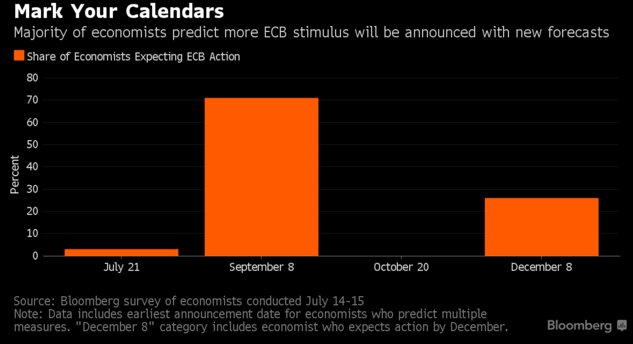
Euro Declines as Traders Speculate ECB Will Signal Dovish Policy.The euro fell to a three-week low against the dollar as investors braced for the European Central Bank’s meeting Thursday amid speculation policy makers will signal further stimulus to counter fallout from Britain’s vote to leave the European Union.
he euro stayed lower after a report showed the region’s current-account surplus narrowed in May. The ECB policy meeting will be the first after the Brexit vote on June 23, and economists in a Bloomberg survey predict the ECB will keep the key rates unchanged for now while assessing the referendum’s potential impact. While the single currency has risen against the pound since the vote, it has declined against most major currencies because of perceived collateral damage.
“We expect the ECB to present more dovish outlook acknowledging that the Brexit vote will provide a significant negative shock to the euro-zone economy,” said Lee Hardman, a foreign-exchange strategist at Bank of Tokyo-Mitsubishi UFJ in London. “It should make the ECB confident enough to signal that further stimulus is likely in September when ECB staff forecasts are updated. Our outlook is for the euro to grind lower.”
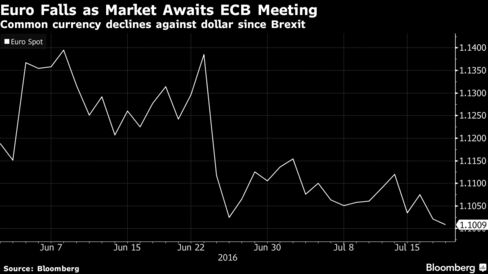
The euro dropped 0.2 percent to $1.1005 as of 11:11 a.m. London time, and earlier fell to $1.0982, the lowest since June 27. It has declined about 3 percent since the U.K. referendum vote. The common currency fell 0.8 percent to 83.41 U.K. pence.
Net Shorts
Wagers on a decline in the currency exceeded those on a rally by 87,660 contracts in the week ended July 12, Commodity Futures Trading Commission data show. That’s an increase from 75,327 contracts in the prior week and the biggest net short position since January. A short investment is a bet that an asset will decline in value.
A report on Wednesday showed the euro region’s current-account surplus shrank in May to 30.8 billion euros from a revised 36.4 billion euros in April. The ECB forecast that the region’s surplus will be equivalent to about 2.9 percent of its economy this year.
For Richard Kelly, head of global strategy at Toronto Dominion Bank in London, the surplus will continue to underpin the euro even as the region’s economic outlook deteriorated and it has more than $3.2 trillion of its bonds yielding less than zero. The surplus signals the euro area is a net lender to the world and it is not reliant on foreign money to finance itself.
“It’s hard to trade the euro with strong conviction at the moment,” Kelly said. “I’d rather be short in the near term because of political uncertainty and possibility that we will have further stimulus from the ECB. But longer-term, the current-account surplus means the euro’s downside is likely to be limited.”
Source:link