
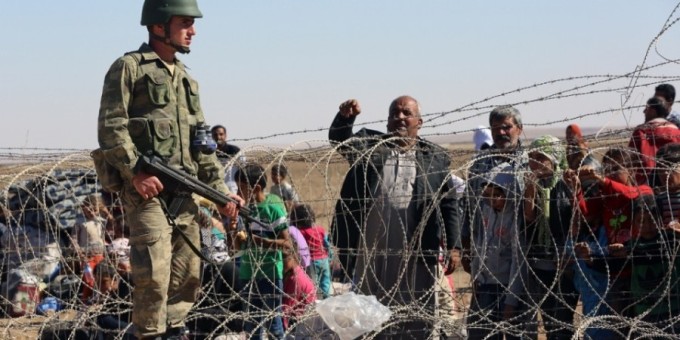
EU refugee expulsion plan under fire from UN.Under fire came the EU’s plan to begin expelling thousands of refugees from Greece on Monday from the UN on Friday as the backlog of migrants detained on Greek islands swelled despite a fall in the numbers arriving from Turkey.
The UN’s refugee agency said there were “serious gaps” in the EU’s plan, which would require nearly all refugees who have arrived in Greece in the past two weeks to be sent back to Turkey. It said a system to give legitimate asylum seekers protection was not yet in place.
“Across Greece … numerous aspects of the systems for receiving and dealing with people who may need international protection are either not working or absent,” the UN told reporters in Geneva.
The number of refugees and migrants arriving on the Aegean islands from Turkey has fallen by about half since an EU-Turkey deal on returns last month. The accord was struck in an effort to tackle the biggest migration crisis Europe has faced since the second world war. More than 1m refugees from Syria, Iraq and other countries arrived in the EU last year, most via Greece and ending up in Germany.
According to data from the Greek migration policy unit, average daily arrivals on Lesbos, Chios and Samos, the main islands targeted by people smugglers, fell from about 700 to just over 300 people since the deal. Overall 26,500 asylum seekers arrived in March compared with 125,000 in the first two months this year.
But even the reduced stream of arrivals is outpacing Greece’s limited facilities for detaining and processing asylum seekers. About 5,000 asylum seekers are being held in overcrowded conditions at former EU screening hotspots on the islands, awaiting return to Turkey.
The UN said conditions in Greece’s processing centres on its outermost islands were “deteriorating”, noting there had been rioting and stabbings at some camps in the past week as migrants become more panicked about their future course.
On Friday, hundreds of migrants detained at the Chios hotspot broke through a perimeter fence and began walking to the island’s main port.
Under the Geneva Convention, refugees fleeing war or persecution cannot be expelled by a signatory country unless their asylum application is heard or they are being sent to a country where international norms are recognised.
Even before the migration crisis, Greece’s asylum system was cited by EU courts for “inhuman” and “degrading” conditions, and European authorities have been trying to set up a legally acceptable process virtually from scratch. In addition, Amnesty International on Friday presented new evidence Turkey is repatriating Syrian refugees in direct violation of international law.
European Commission officials insisted they were addressing UN concerns, saying they were working to send an additional 2,500 judicial, policing and migration personnel to help Greek authorities and upgrade the camps and processing centres to international standards.
“What we are, of course, doing is to put all the necessary factors in place so the deal can be implemented,” said Mina Andreeva, a European Commission spokeswoman. “We are working to make sure the deal is legally sound and people are returned only in accordance to EU and international law.”
But Ms Adreeva declined to say whether the EU would halt the Greek expulsions if UN objections persisted on Monday. “We are not going to engage in any ‘if’ questions,” she said.
The Syriza-led government on Friday reiterated its commitment to the returns policy, which has been criticised by some high-profile party cadres as illegal and inhumane. It said the first returns would be made on Monday as agreed with Brussels.
New legislation bringing Greece fully into line with EU directives on migration and asylum was due to be approved by parliament on Friday night. To assuage Syriza lawmakers’ concerns over the legality of returns the law did not specify Turkey as a safe third country for asylum seekers.
Amnesty, in a report that further weakened the EU’s case, said it had evidence that Turkish authorities were engaged in “large-scale forced returns of refugees” to Syria — which would be a violation of international law and, as a result, make Greek returns to Turkey illegal.
The report found that “groups of around 100 Syrian men, women and children” have been sent back to the war-torn country “on a near-daily basis” for the past two months, with “large-scale” returns from the southern Hatay province this week.
“In their desperation to seal their borders, EU leaders have wilfully ignored the simplest of facts: Turkey is not a safe country for Syrian refugees and is getting less safe by the day,” said John Dalhuisen, Amnesty’s head of Europe and central Asian operations.
Natasha Bertaud, the EU Commission’s migration spokeswoman, said Brussels had received assurances from Ankara that it would pass new laws by Monday making such returns, known internationally as refoulement, legal. She added that the EU’s lead co-ordinator on implementing the expulsion plan was meeting Turkish authorities on Friday to gauge progress.
Ms Andreeva said: “We take every allegation seriously and we will examine them, of course. We will raise, and are raising, these issues in our contacts with Turkish authorities.”
Source:link